How Bootstrapped Founders Price a SaaS App They Built Without Developers
Low upfront costs force bootstrapped SaaS founders to price on value, not build expense.

A founder who builds without developers doesn't just save money on the build. They inherit a completely different cost structure, and that structure changes every pricing decision that follows. This piece walks through what that actually looks like, from the monthly bills nobody warns you about to what real bootstrapped products charge and why.
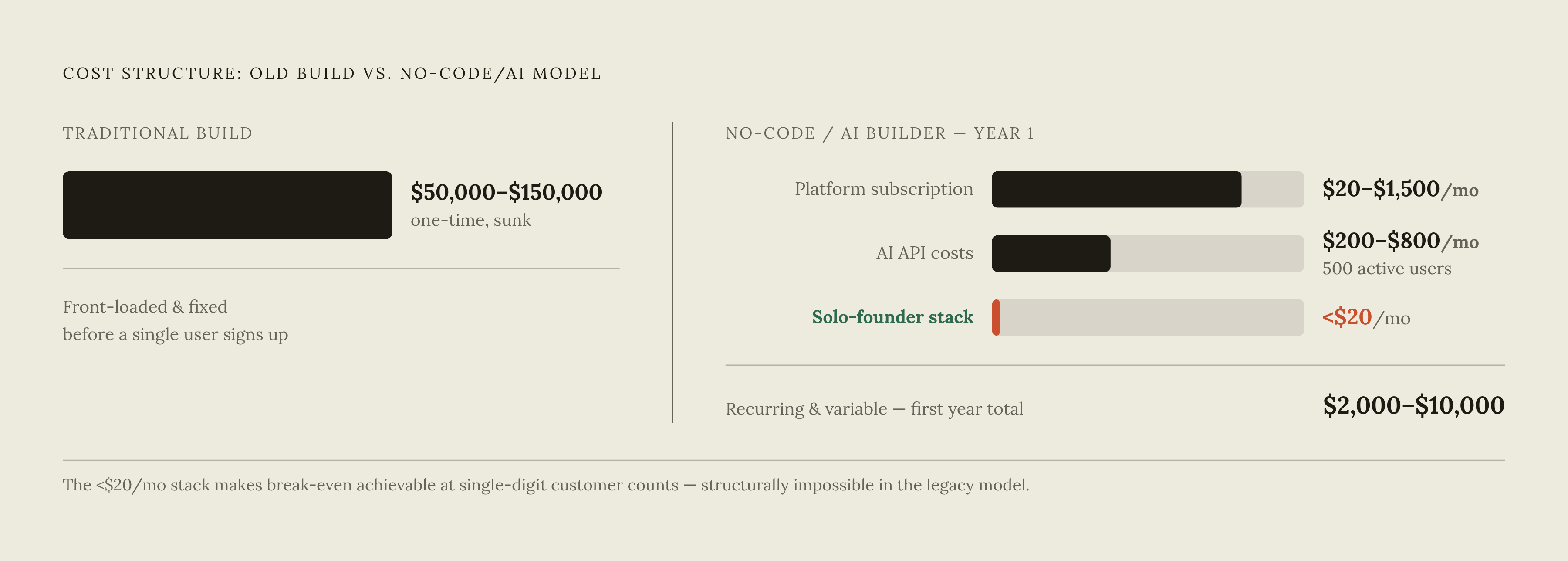
The old math is well known: an agency-built MVP runs $50,000 to $150,000 or more, and burns cash before a single customer has paid a cent. The no-code and AI-builder path in 2026 looks nothing like that. Cost research drawing on a survey of 213 founders and analysis of 89 completed AI builder projects documents working, deployable products built for under $100 and a few hours of effort. That's not a modest improvement on the old model. It's a structural break, because a founder who spent $0 to build does not share the same break-even math as one who spent $80,000, and pretending otherwise leads to pricing decisions that make no sense.
This shift isn't a fringe experiment either. The global SaaS market hit $408 billion in 2025 and is projected to reach $465.03 billion by the end of 2026. Gartner's forecast has 75% of new enterprise applications built on low-code or no-code platforms, up from under 25% just five years earlier. So how to price a no-code SaaS is a mainstream commercial question, not a niche curiosity. It's a mainstream commercial question, and most of the pricing advice floating around still assumes the old cost structure. Here's what actually holds up once you throw that assumption out.
What running a no-code SaaS costs per month once it is live
Build cost and run cost are not the same thing, and conflating them is probably the single most common mistake among first-time no-code founders. Spending a modest sum to launch a product doesn't mean the product costs that same modest sum to keep alive. It means the one-time cost was a small amount. The recurring cost is a separate number, and it's the number that should actually drive pricing.
A realistic all-in first-year cost for a bootstrapped AI SaaS is somewhere between $2,000 and $10,000. That figure covers platform subscriptions, hosting, and API usage, not development labor, because there isn't any.
Platform subscription costs vary a lot depending on the stack. Entry-level paid tiers from leading no-code builders run $20 to $50 a month. But once an app has real, active business usage, and needs workload add-ons, plugins, or extra storage, costs on a platform like Bubble can climb to $300 to $1,500 a month. That range matters enormously for tier design later on, so hold onto it.
Then there's the credit trap. Most AI-native builders charge a base subscription plus a metered pool of AI usage. A busy month, with more customers doing more things, can cost two to five times the advertised base price. This is arguably the biggest pricing trap of 2026 for founders picking a stack, because the sticker price on the landing page is not the price you'll actually pay once real usage kicks in.
AI API costs add another variable. GPT-4o costs around $2.50 per million input tokens, and a product with 500 active monthly users making regular AI requests typically costs between $200 and $800 a month in combined platform and API costs, before a dollar of revenue comes in.
There's a leaner path, though. A solo founder's stripped-down stack, build tool, database, payments, email, analytics, can run under $20 a month before revenue. Roughly 60% of the public case studies in the research followed some version of this setup. It's cheap, and cheap-and-predictable beats flexible-and-volatile when you're trying to price with confidence.
None of this accounts for time. Reaching real proficiency on some no-code platforms can take 100 to 300 hours. That never appears on an invoice, but at any reasonable valuation of a founder's time, it's a real cost, and ignoring it is how founders end up working for less than minimum wage on products that look profitable on paper.
The floor a founder needs to price above is the monthly run rate plus the founder's own implicit time cost. It's the monthly run rate plus the founder's own implicit time cost. Knowing that number precisely, down to the dollar, is the prerequisite for every tier decision that follows. Skipping this step makes every price you set afterward a guess.
How near-zero build cost reshapes the meaning of "value" for early customers
The old pricing formula goes: cost to build, plus margin, plus a glance at what competitors charge. That logic still runs through most founders' heads, even when it no longer applies to their situation.
When the cost to build is near zero, that formula collapses, because there's no meaningful cost to recover. The only anchor left that actually holds weight is value delivered to the customer. What pain does the software remove? What does that pain currently cost the customer in hours lost, money wasted, or risk carried?
Something interesting happens once build cost drops out of the equation: the person who understands the problem most intimately becomes the same person who can ship the solution. An ex-nurse building practice management software. A logistics coordinator building a dispatch tool. Domain expertise, not technical skill, becomes the asset that determines outcomes, because the code is no longer the hard part.
That changes what pricing should reflect. It should track the founder's domain knowledge and how specific the problem is, not the hours spent prompting an AI builder into shape. A vertical CRM built for solar panel installers can charge $200 a month, and customers will pay it, because it solves problems a generic CRM doesn't even know exist. The value sits in the specificity, not in how sophisticated the underlying code happens to be.
Compare that to a generic productivity tool built at the exact same near-zero cost. It has no vertical moat, so it faces immediate price compression the moment a competitor undercuts it. Same build cost, wildly different pricing ceiling, and how targeted the problem is entirely decides that gap.
So before setting a single tier price, a founder needs real answers to a short set of questions. How much time does this problem currently cost the customer, in hours per week? Who else claims to solve this, and how well do they actually solve it for this specific customer segment? What would the customer pay a person to do this manually? Those answers set the ceiling. Pricing below it is a strategy choice. Pricing above it is a mistake nobody wants to discover after launch.
The three pricing models bootstrapped no-code founders use, and when each one fits
There are three models that appear again and again in the data on real bootstrapped no-code products, and each one fits a different relationship between the customer and the value they're getting.
Flat subscription tiers are the most common choice, and for good reason. They're predictable for the founder and easy for the customer to understand at a glance. This model works best when usage is fairly uniform across the customer base and the value delivered doesn't swing wildly from one customer to the next. The risk is under-pricing heavy users while over-pricing light ones, if the tiers aren't calibrated carefully. A compliance SaaS in the research priced basic scans at $299 a month, scaling up to $2,000 a month for enterprise-level monitoring. That jump is justified by what the customer would otherwise spend on legal team hours, not by what the software costs to run. It's justified by what the customer would otherwise spend on legal team hours.
Usage-based or per-unit pricing ties cost directly to value received, and it scales naturally with the customer's own success. It works best when the product's output is something you can literally count: emails sent, reports generated, routes optimized, RFPs processed. A waste management route optimizer in the research charged $49 per truck per month, and the customer's return was direct and calculable in fuel savings, which made the price an easy sell. The tradeoff for the founder is revenue variability. A slow month for the customer becomes a slow month for the founder too.
Hybrid pricing, a flat base plus usage overage, shows up a lot in the AI-native builder space. It's also, according to the research, the biggest trap founders fall into when they adopt it without planning ahead, because their own platform costs can spike in exactly the same months their customers' usage spikes. This model only works cleanly when the founder's own infrastructure costs are predictable. Otherwise, margin compression occurs suddenly and without warning.
Picking between these three shouldn't come down to what a competitor is doing, or what's easiest to configure in a billing tool. It should come down to how the customer actually experiences value: per use, per period, or per outcome. Get that relationship right and the pricing model picks itself.
Designing tiers that reflect a zero-dev-cost margin structure
Real founder data puts the average profit margin across documented micro-SaaS products at roughly 64%, with the highest-margin categories, developer tools especially, running even higher. That's the landscape a bootstrapped founder should be aiming for, not some aspirational ceiling out of reach.
Yet a near-zero build cost is a margin gift that plenty of founders manage to give right back, usually in one of three ways.
First, giving away too much for free trains customers to expect the full product at no cost, and converting them to paid later becomes an uphill fight. Second, pricing to undercut a competitor rather than pricing to value. Anchoring against a competitor's price without knowing that competitor's cost structure, which might include a full developer team, destroys margin for no strategic reason. Third, ignoring the scaling wall. Platforms can spike to $300 to $1,500 a month at active business scale, and a founder who priced their tiers assuming a $29 to $32 a month starter cost is going to hit a margin cliff, hard, if that scaling cost wasn't built into higher tiers from day one.
A few principles make tier design hold up under real usage. The entry tier, free or low-cost, should deliver genuine value, but it needs to gate whatever feature actually drives the customer to come back: a usage limit, a report cap, a seat limit. The mid tier should comfortably cover all platform run costs on a small number of customers. It shouldn't require hundreds of free-to-paid conversions just to break even, because that's not a business model, that's a hope. The top tier, or enterprise pricing, should be set against the customer's value ceiling, not against the founder's costs. This is exactly where vertical specificity pays for itself.
Infrastructure choice bleeds directly into all of this. A founder on a platform with unpredictable credit or token billing can't offer stable flat tiers without quietly absorbing margin risk every single month. A founder on infrastructure with flat, predictable subscription pricing can build tiers that actually hold up over time.
What real bootstrapped founders charge, and what their revenue looks like
Honesty first: the average micro-SaaS earns around $1,735 in monthly recurring revenue at that roughly 64% margin. The median profitable product lands closer to $4,200 MRR, call it $50,000 a year. The median product overall, profitable or not, earns closer to $500 a month. Most never break out past that.
But roughly 15% do scale past $10,000 MRR, and a handful go much further. Photo AI, built solo by Pieter Levels, runs somewhere around $100,000 to $105,000 MRR doing AI photo generation. Carrd, a one-page website tool built solo by AJ, is at $360,000 ARR, kept deliberately small and priced for volume at a low per-customer price. Senja, a two-person testimonial collection tool, does $83,000 MRR. Fathom Analytics, privacy-first analytics built by two people, runs at a multi-million-dollar ARR. And Marc Lou's portfolio of small products pulled in a seven-figure sum over the past year, spread across products like ShipFast (which publicly reported around $20K a month), DataFast ($15.8K MRR), and VirallyBot ($4K MRR, before being shut down by COVID). These figures come from founders' own public reporting, build-in-public updates, revenue dashboards, interviews, so treat them as directional snapshots rather than audited numbers.
The contrast between Carrd and Photo AI says a lot about how differently pricing logic can work and still succeed. Carrd wins on volume, a low price, and near-zero support overhead. Photo AI wins on a high-frequency consumer use case where value scales directly with usage. Two completely different pricing philosophies, both profitable, and neither one is "the right way." None of this should read as a promise. It's a range, and the pricing logic behind each point in that range matters more than the dollar figure itself.
This isn't limited to technical founders dabbling in no-code as a shortcut. Jacob Seeger scaled faceless.video, built entirely on a no-code platform with zero coding experience going in, to seven-figure revenue. The no-code path produces real commercial outcomes. Not toy products, not proof-of-concepts. Actual revenue.
The infrastructure choice that pricing depends on most, and what it costs to get it wrong
Here's the tension a lot of founders don't see coming. Stitching together separate services for hosting, database, authentication, email, and storage gives a founder flexibility, sure, but it also means absorbing costs that move independently and compound in ways that are hard to predict. And unpredictable costs make stable pricing tiers nearly impossible to hold onto.
The math on stitching together your own stack: platform costs can run $30 to $300 a month depending on user volume, before API costs, before storage, before email. And before the time cost of managing all those integrations, which is the hidden line item that never appears in a side-by-side comparison table but eats real hours every month.
The alternative is an all-in-one managed infrastructure layer, one that bundles backend, database, hosting, auth, email, and integrations into a single flat subscription. That's what turns a founder's cost floor into a known, fixed number, and a known cost floor is what makes pricing tiers actually defensible instead of aspirational.
The pricing consequence follows directly from that choice. A founder with unpredictable infrastructure costs cannot confidently set a margin target, full stop. A founder with flat infrastructure costs can set tiers, model a break-even point, and grow into those tiers with actual confidence. This is a pricing prerequisite that gets decided before a single price ever goes on a page. It's a pricing prerequisite that gets decided before a single price ever goes on a page.
The practical steps a bootstrapped no-code founder should take before setting their first price
Start with the number that matters most: the actual monthly run rate. Adding up every subscription, every API cost, and an honest estimate of time cost gives the real total. That total is the floor. It is not the build cost, and it never was.
From there, find the customer's value ceiling. What does the problem cost them today, in time, in money, in risk carried? Price below that ceiling. Never price against your own costs plus a margin and call it a day, because that number has nothing to do with what the customer is actually willing to pay.
Choose a pricing model that matches how the customer experiences value, per period, per use, or per outcome, before landing on an actual number. The model comes first. The figure comes second.
Lock in infrastructure before locking in tiers. A platform that bills by credit or token gives a founder a cost floor that moves every month, and tiers built on a moving floor are wrong by definition. Predictable, flat-priced infrastructure comes first.
And finally, watch for the real signal: users asking if they can pay. When that happens, the answer is to incorporate and start charging, not to keep refining the product in silence. That question, coming from an actual user, is worth more than any amount of market research a founder could run beforehand.