Bootstrapped Founders Who Launched a Micro-SaaS Without a Technical Co-Founder
No-code tools and AI builders now let solo founders reach profitability without technical partners.

The share of new startups launched by a single founder has climbed sharply and steadily, and among bootstrapped companies the solo rate now runs more than double what it is among VC-backed startups. It reflects a real change in what one person can build alone, with no engineering team and no technical co-founder sitting across the table.
The minimum viable stack for a no-code micro-SaaS product, an AI builder for the product itself, Stripe for payments, and one support tool, runs $50 to $200 a month in total. A development budget that once ran into the tens of thousands of dollars before a founder could even test an idea is no longer required for products that fit this model. Citizen developers, people building software without a formal engineering background, now outnumber professional developers by roughly four to one, and Stripe has described solo founding as running at an all-time high.
That shift raises a sharper question than whether the barrier fell. It asks who actually crossed it, and what their path from idea to paying customers looked like in practice. The founders profiled below answer both.
A solo founder built Base44 alone, reached substantial recurring revenue with a large user base, and sold it to a major acquirer for a sum in the tens of millions
Maor Shlomo built Base44 without a technical co-founder, treating his own time as the scarce resource and using automation to multiply it, a pattern that recurs across the solo founders who reach scale. The number that matters as much as the sale price is what Shlomo did before the revenue arrived. He spent his first months tracking exactly where his time went, then built automations to reclaim it. That included AI agents designed to sift through user feedback and surface product ideas, and separate agents to crawl his own platform and flag UX problems, the kind of work that would ordinarily need a product manager, a QA engineer, and a developer working together.
The Base44 story is a systems story: Shlomo treated his own time as the scarce resource in the business and used automation to multiply it, and that exact pattern recurs across the solo founders who manage to reach real scale. The lesson generalizes past Base44 itself. A founder working alone has exactly one unit of time per day to spend, and the founders who get the most out of that unit are the ones who build systems to do the parts of the job that don't require their judgment, freeing their judgment for the parts that do.
Three more founders who shipped fast and reached real revenue without a technical partner
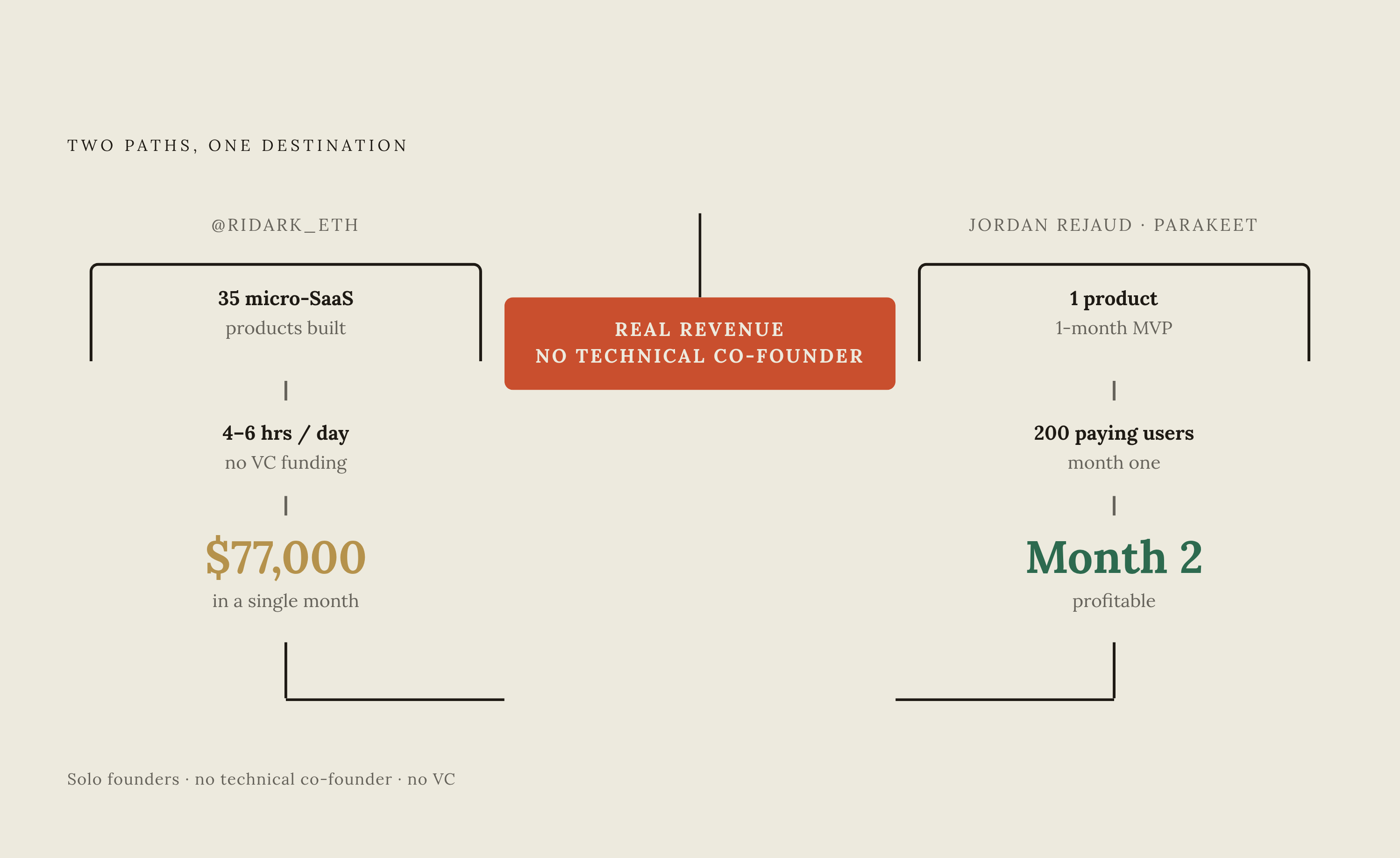
A solo developer documented under the handle @ridark_eth built 35 different micro-SaaS startups and hit $77,000 in a single month, using no venture funding, a basic code editor, and a single AI chat window, working 4 to 6 hours a day. Jordan Rejaud built the MVP for Parakeet Chat in one month, reached 200 paying users in the first month, hit profitability in the second month, and generated substantial revenue within its first year.
Across all three cases, the pattern repeats in the same order: a narrow problem, a fast build, and real paying users arriving before the product was anywhere near polished. None of these founders followed a long development cycle that ended in a single launch event. They shipped something small, found out fast whether people would pay for it, and kept building only the parts that earned their keep.
The contrast between @ridark_eth's volume approach, 35 separate products built for speed and portfolio scale, and Rejaud's single-product, profitability-first approach shows there isn't one right shape for this path. Some founders test many small bets. Others build one product and push it to profitability as fast as possible. Both reached real revenue without ever hiring a technical co-founder.
The middle-of-the-curve outcomes: what a typical solo micro-SaaS build looks like
Jacky Tan built CraftMyPDF, a no-code PDF template editor, for minimal upfront cost and grew it to a solid five-figure annual revenue. That outcome is a representative middle-of-the-curve result, exactly the kind most solo founders in this space should expect: a real, durable business built around one narrow B2B workflow, run without outside funding.
Tan's result is not an outlier dressed down to look modest. The Freemius State of Micro SaaS 2025 report found that most of the micro-SaaS businesses it analyzed reach profitability within their first year, and that lines up directly with what these individual cases show. Profitability inside year one, on a product built by one person for a few hundred dollars a month in tooling costs, is the realistic target for this model. It is not the exception.
The trade-off is this: solo micro-SaaS gives up the unicorn upside that venture-backed startups chase, in exchange for full ownership, operating costs that stay flat as revenue grows, a pace the founder can sustain without burning out, and a real path to an exit. Profitable micro-SaaS products at meaningful monthly recurring revenue trade on marketplaces like Acquire.com and Flippa, priced at multiples of profit using Seller Discretionary Earnings rather than revenue multiples. Solo micro-SaaS gives you an exit option most VC-backed founders never get to use, because their companies are built to swing for an outcome far larger or nothing at all.
Why niche specificity is the actual moat
Every founder profiled so far made one decision before any of the building started: what, exactly, to build. The niches that turn into profitable micro-SaaS businesses share three traits. They involve a repetitive workflow, they serve an audience that already pays for software, and they have no dominant vertical incumbent standing in the way. The niche has to be specific enough that a horizontal competitor, a company selling general-purpose project management or scheduling software, has no real reason to build a feature for it.
Job listings and forum complaint threads, read closely, function as product specifications written in the buyer's own words: a dental office job posting that asks someone to manage "appointment confirmations across phone, email, and text" describes a product to build.
Founders who get the niche right tend to run their idea through a short filter before building anything: can the niche be named in one sentence with three specifics? Can the job the product does be named in a single verb? Would the target user actually pay a monthly subscription for it? These questions work as elimination filters, not brainstorming prompts, and most ideas fail them quickly.
Non-technical founders carry one advantage that technical founders typically lack: deep, specific knowledge of an industry they've actually worked inside. That knowledge has a shelf life. It is most valuable immediately after a founder leaves the industry, before the specifics fade into general impressions. Most failed attempts skip this step entirely: they ship a feature a horizontal tool already covers, then launch into a market too broad to defend. Niche selection, not the build and not the underlying technology, is the point where most attempts actually fail.
Validation before building is the discipline that separates the founders who shipped from the ones who stalled
Speed in the case studies above looks like luck from the outside, but it isn't. The founders who moved fastest had already answered the hardest question before they wrote a single prompt: would a stranger pay for this?
The gate that actually matters here has nothing to do with technical skill. It is whether a stranger, someone who isn't a friend and isn't a LinkedIn connection doing a favor, commits something with a real cost attached before the product exists. A deposit, a pre-payment, a scheduled onboarding call, or an email address given deliberately, all of these count as that commitment.
Rejaud's one-month build, his 200 paying users in month one, and his profitability in month two were not the product of speed alone. They reflected validation done before the build: confirmation that the problem was real and that people would pay at the price he set. A single buyer who takes a discount still teaches a founder more than a hundred people who sign up for free. The most common failure in this entire category is subtle and easy to miss from the outside: the founder has identified a real problem, but found it by reasoning about a market rather than by direct contact with people living it, and has never actually watched someone experience it. A problem you arrive at through logic feels exactly as convincing as one you confirm through direct observation, but once money enters the picture, the two behave in completely different ways.
Tools and the All-In-One Versus Stitched-Stack Decision
Once a founder has validated the idea, the next decision is whether to build on one all-in-one platform or stitch together a set of specialized services, and that choice compounds as the subscriber count grows.
The stitched-stack approach carries a trap that is easy to miss at launch. Automation tools priced by task volume look cheap in the first month, but as workflow volume rises, they turn into a significant recurring cost. A solo founder running a content subscription with a few hundred subscribers, automated weekly emails, payment processing, and member management can burn through an entry-level automation plan in days, and the cost gap between automation platforms at that volume adds up fast.
The all-in-one approach carries the opposite risk, which appears later rather than earlier. By the time a startup reaches meaningful size, it is typically running a large number of separate SaaS subscriptions plus an integration layer holding them together, and that integration tax, paid in both dollars and in operations time, adds significantly on top of the headline subscription costs.
On the backend specifically, Supabase has become the default recommendation among indie hackers who build this kind of product. That last point matters for founders who expect to grow past what no-code tooling can comfortably handle: the backend choice made on day one determines how painful that migration will be.
The quality of the product specification matters more than the sophistication of the tool
One rule, attributed to a founder referred to as Green, captures the discipline that produced the result: no writing code, only copying and pasting AI-generated output directly into files. What made that rule work was not the rule itself. It was what came before it: knowing with precision what the product needed to do before a single prompt got typed.
The garbage-in, garbage-out principle governs this entire category of building. A founder who can write a sharp, detailed product specification gets dramatically better output from an AI builder than one who prompts with a vague concept, because the tool amplifies whatever judgment it's given. The real skill behind every founder profiled here is not technical ability, but the ability to specify a problem precisely enough that a tool built to amplify judgment has good judgment to amplify. The barrier that collapsed was the cost of building. The discipline that remains, unchanged by any tool, is knowing what to build and for whom.