Community Platforms Solo Founders Use to Find Early Users and Feedback
Solo founders need honest participation in niche communities, not Product Hunt launches.

Finding early users and useful feedback in 2026 takes more than a Product Hunt launch. For solo founders, the better approach is a deliberate combination of communities chosen for a specific need, whether that is signups, product criticism, pre-launch testing, or accountability. The common rule is simple. Taking part honestly gets more attention than posting pitches.
Why Product Hunt no longer works as a primary launch channel in 2026
A launch-day traffic spike can look like progress without producing much of it. That gap reflects the audience’s intent. People arrive to browse new products. A visitor who finds something interesting is not the same as a prospective customer.
As submission volume dilutes discovery, Product Hunt is a weak default for a solo founder’s primary launch channel. It still has a narrower use, including a “Product of the Day” badge that serves as a credibility asset by adding social proof to a landing page. Treating a submission as a one-time opportunity for that asset gives it a sensible place in the launch plan. It also leaves the work of finding customers where it belongs, with audiences that have a reason to act.
Why honest participation — not promotional posting — is the operating principle across every platform that works
The communities that produce real signups are organized around shared problems. Members distinguish between people who contribute and those who appear only to drop a pitch, extending goodwill to contributors. On Reddit, that distinction has direct consequences. Promotional posts from accounts without community history can be removed or downvoted into invisibility. Access to the posting box does not mean access to the community’s attention.
The unwritten rule across r/SideProject, Indie Hackers, and Hacker News is to earn the right to mention a product by helping first. That principle matters for feedback as much as for acquisition. Consistent, honest participation builds trust, and that trust affects the quality of the responses a founder receives. The platform map therefore guides the choice of where participation will be relevant enough to sustain.
Where to go for signups: Reddit communities with the right audience fit
For solo founders who need signups, the right Reddit community is the best public place to start. Approached honestly, it can deliver more signups per visitor than the other public platforms in this map. The advantage is not simply the size of the audience. A subreddit gathers people around an interest or problem, so a product that fits can meet intent that already exists.
A community can contain people who would use the product or merely people who find products interesting. r/SideProject is a large, highly active community where founders share what they are building. Its norm is to lead with the product and what it does. That makes it a natural place to look for early users, but the audience still has to match the use case. A founder audience is not automatically a customer audience.
By contrast, r/startups serves a broader audience and is more useful for gut checks and blunt feedback on idea validation. It is better suited to early-stage questions than product launches. That distinction matters even within Reddit, because a community can be useful without being the right acquisition channel. The value of a response about an idea is different from the value of a signup. Choosing between them starts with knowing which one is needed.
For founders building with AI tools, r/vibecoding offers a more specific fit. It launched in 2025 and is growing rapidly, giving early participants an advantage while the audience expands and its norms are still forming. Its relevance comes from that shared way of building. If the product has no clear connection to what members need, the match is weak.
Where to go for candid peer feedback: Indie Hackers and Hacker News
Signups reveal that someone was willing to try a product, but they do not explain everything that needs fixing. Indie Hackers and Hacker News offer criticism from people who know what it takes to build. Both can produce candid, actionable input, but their audiences and standards differ. Indie Hackers is centered on the practical work of building an internet business. Hacker News is a technology forum where people look closely at technical claims.
Indie Hackers is the strongest fit for bootstrapped founders building profitable products, SaaS tools, newsletters, and solo-operated companies. Its conversations focus on revenue, launches, customer acquisition, and the gap between an idea and traction. That gives business-stage questions a natural home without requiring a venture capital frame. A founder trying to understand a launch or an acquisition problem is bringing the kind of issue the community already discusses.
Transparent revenue data, build-in-public updates, and candid post-mortems are central to that exchange. Still, the quality varies by thread, and the audience skews toward online businesses and software products. It is less well suited to local businesses and fields with heavy regulation. Indie Hackers is useful because of its focus, and that same focus sets its limits.
Hacker News has an audience dense with engineers, founders, and technical operators, making “Show HN” a genuine launch channel for products that benefit from technical scrutiny. Responses can include substantive technical critique and market-sensing feedback, sometimes from people who become early users. People are blunt and often skeptical, so it is a better fit for technical founders, developer tool builders, and deep tech products than for businesses in general. The practical distinction is clear enough. Bring a business-stage question or launch update to Indie Hackers, and bring a product or technical claim to Hacker News to find out whether it holds up.
Where to go for pre-launch validation: BetaList and Uneed
Some founders need people willing to try an unfinished product and help establish what needs work. BetaList and Uneed help at that stage by showing new tools to people who want to try them. Their role is validation.
BetaList is specifically designed for products that have not fully launched. Products are reviewed after they are submitted, before early adopters looking for beta and alpha-stage tools get to see them. That makes it a fit for founders who need testers and early feedback before committing to a public launch. The audience’s willingness to try unfinished tools is the important distinction. BetaList is not a substitute for finding a broader customer audience later.
Uneed positions itself as a maker-first alternative to Product Hunt, with a supportive community orientation. It belongs in the map as another place to surface a product while its message and usefulness are still being refined. That positioning is different from BetaList’s explicit focus on products before full launch, so the two should not be treated as identical. Neither should carry the whole acquisition plan. Their best role is to help refine the product and its message before moving to higher-volume communities.
Where to go for accountability and longer-term peer support: WIP, Small Bets, and Ramen Club
Launch communities are built around moments of attention, but solo founders also need to keep working between those moments. Other communities help with that through accountability and ties between peers that grow over time. Instead of responding to a single post, members can follow a founder’s progress. That makes these communities a complement to public forums.
WIP is a maker community built around shipping accountability. It is free with an invite and has an optional paid Pro tier, so describing it simply as a paid community misses an important distinction. Members log their progress each day, and the way the community works helps hold them to it. That makes WIP particularly relevant to founders who struggle with consistency between launches.
Small Bets addresses progress through a different philosophy, which is to test smaller ideas before committing to full products. It combines a community with a class library and emphasizes experiments and practical iteration. Daniel Vassallo started it after leaving a high-paying corporate job to build a portfolio of small products. The community reflects that approach. It suits indie founders who want to validate multiple ideas quickly instead of committing fully to one before learning anything.
Ramen Club offers another form of continuity through a Slack community of over 400 founders and a physical co-working space called Ramen Space in East London. Each week it has demo days, interviews with founders, and workshops led by experts, and members get partner perks. The combination of an active online community and a consistent in-person presence makes it particularly relevant to London-based founders who want both. Its appeal is therefore not just access to discussions, but a setting for ongoing peer contact.
These options solve different problems, so paying for membership is not the principle that ties them together. Smaller, more curated communities become useful when a founder has a specific need that a public forum cannot meet, and cost can act as a filter. WIP’s free-with-invite model also shows that structure does not have to mean paid access. The important match is between the founder’s difficulty and the community’s way of supporting progress. The right accountability structure keeps founders active between launches. Early-stage work often stalls during those intervals.
How to decide which combination of platforms to use based on what you actually need right now
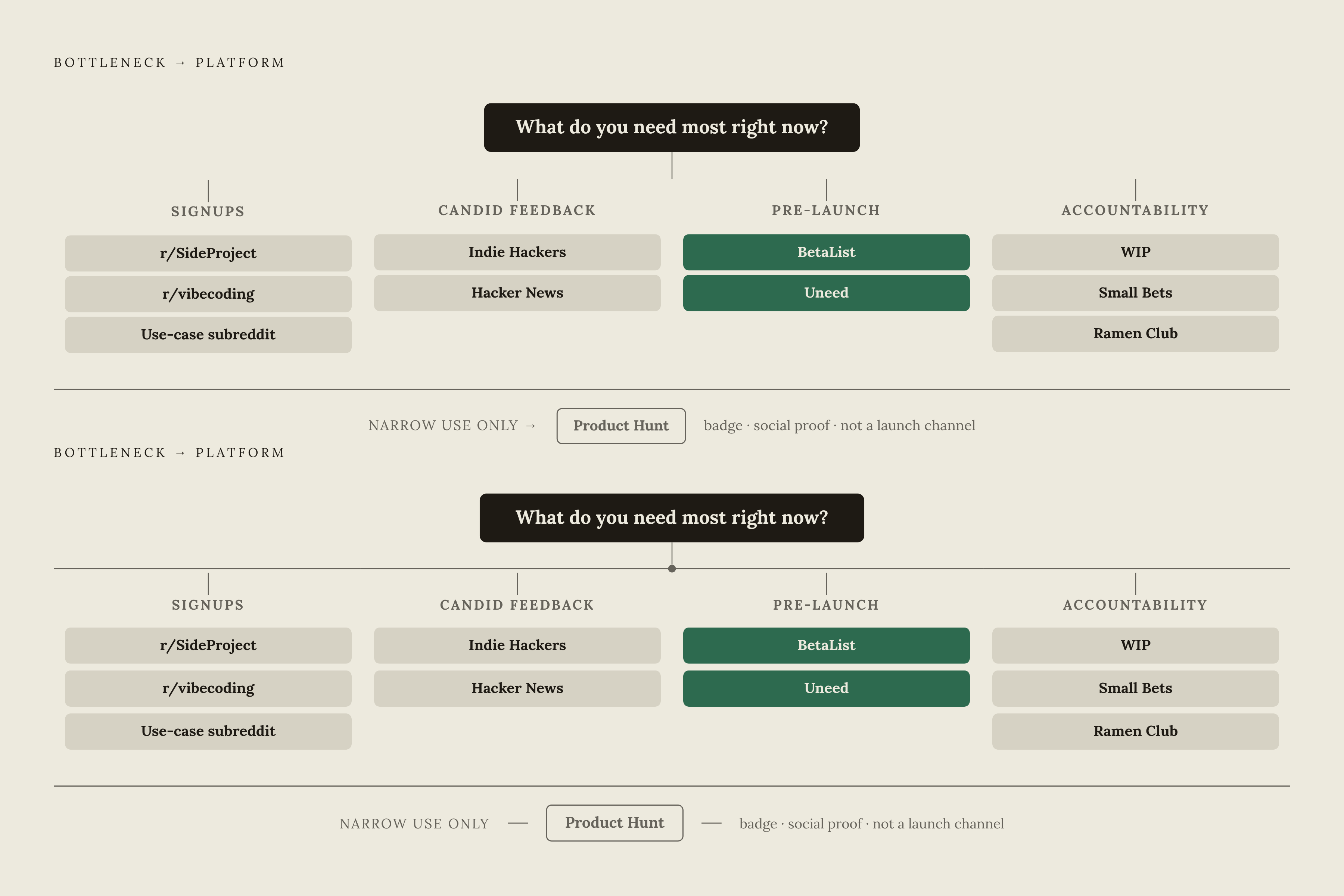
The choice starts with the current bottleneck. If signups are the immediate need, the right subreddit is the strongest starting point. r/SideProject and the subreddit most specific to the product’s use case are the first places to look, with audience fit deciding which deserves attention. A genuine post belongs in a community where the product has a reason to matter. It does not become relevant merely because promotion is possible there.
If the main need is honest feedback, the choice depends on the question. Indie Hackers fits business-stage questions, transparent metrics, and the practical problems of turning a product into a business. Hacker News fits technical or product-level critique when the product can withstand a skeptical audience. Before full launch, BetaList and Uneed can instead provide a validation setting for refining the product and its message. If the obstacle is keeping work moving, WIP, Small Bets, or Ramen Club addresses a need those launch environments do not.
There is a serious objection to this map, however. Founder communities can optimize for peers rather than customers, and the people willing to discuss a product may not represent its target market. A founder whose customers have little connection to tech should weigh time spent in these communities against reaching out to those customers directly. Useful peer feedback does not make those peers prospective buyers.
Going deep in one or two produces better results because recognition and trust accumulate through consistent presence. The combination should reflect the work needed now, such as a relevant subreddit for signups and a structured community for accountability. Product Hunt can retain its narrow credibility role without carrying the launch. Choose places where the audience’s intent matches the need, then participate honestly enough for that match to matter.