Revenue Milestones That Change How a Solo Founder Operates
Growth milestones reveal what stops working as customers multiply.

A revenue milestone doesn't tell a solo founder that the idea worked. It tells them that the way they've been operating is about to stop working. Each threshold, from the first revenue to successive multiples beyond it, exposes a different piece of the business that the founder has been doing by hand, by instinct, or by sheer hours, and that can no longer hold at the next volume of customers.
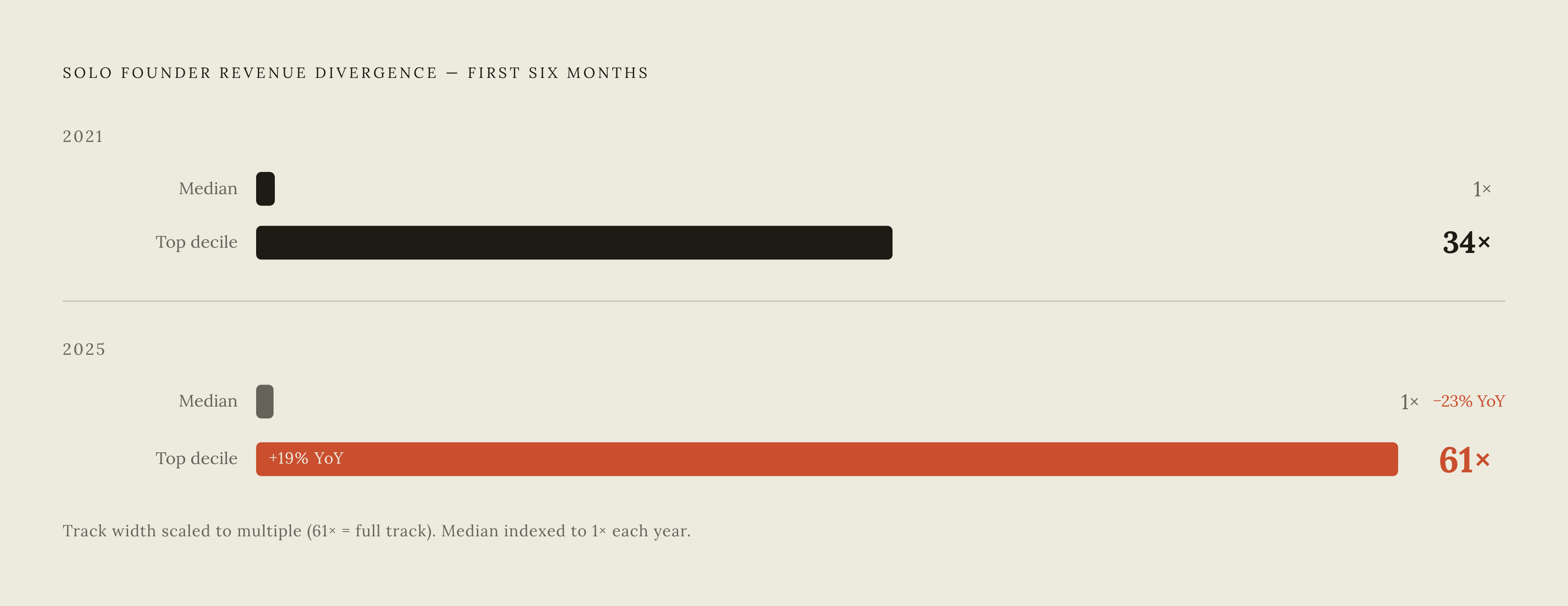
This matters to more people now than it did a few years ago. Solo founders accounted for 63% of C corps formed through Stripe Atlas in the second quarter of 2026, an all-time high. At the same time, the field is splitting apart. Median first-six-month revenue among solo-founded Atlas startups fell 23% year over year in 2025, while revenue at the top decile rose 19%. Four years ago, top-decile solo founders made about 34 times the revenue of the median founder in their first six months. By 2025, that multiple had grown to 61 times.
That widening gap is not random. It tracks almost exactly with how founders respond to the operational breakpoints ahead of them. The milestones that follow aren't a checklist of things to add. Each one names what the founder was doing to get there, what breaks under the new load, and what has to change for the business to keep climbing.
What the first dollars of recurring revenue prove
The first substantial run of monthly recurring revenue proves that someone, somewhere, was willing to pay for what got built. That signal does not prove it is not proof of a repeatable business. At this stage the entire operation runs through one person: the founder writes the code, answers the support ticket, posts about the product, and closes the sale, often all in the same afternoon.
That full-stack role makes early traction possible. One person moving fast, with no handoffs and no approval chains, can ship a product and find its first buyers faster than almost any team. But the same setup that makes the first dollar possible is the one that can't produce the next hundred thousand without changing shape.
A distribution problem is already sitting underneath this stage, even though it rarely looks like one yet. AI has made building fast and cheap, so the constraint that used to sit in development has moved to acquisition. Most founders at this early stage haven't had to face that shift directly, because the volume is still small enough that a founder's personal network, a few posts, or word of mouth can cover it.
The founders who go on to break out treat distribution differently from day one. Top-decile solo founders began selling into an average of ten countries in their first month, compared with three for median founders, reflecting a founder who built distribution into the product from the start rather than treating it as something to figure out once the product was "done.
The early-growth shift: from building mode to channel mode
Somewhere past the earliest traction, roughly a doubling of that initial revenue, the improvisation that got a founder this far stops being enough. Reaching this band requires a customer acquisition channel that works reliably and repeatedly, built on a consistent approach rather than one-off wins stitched together from whatever got attention that week. Founders who haven't found that channel tend to stall right here, revenue flattening even as effort stays high.
What has to stop is as important as what has to start. Early on, successful founders put nearly all their development time into core functionality and getting the product usable. Past this threshold, the highest-performing founders redirect a large share of that time toward integrations, API connections, and workflow automation, the kind of features that don't win a first sale but do win a second, third, and tenth month of retention. Payment processing, automated email notifications, third-party login, workflow automation: these move from nice-to-have polish to the mechanism that keeps customers from leaving.
Pricing becomes a hidden lever at this stage, and it trips up more founders than almost anything else. Founders who priced too low to get early traction hit this band and then plateau, because a low average revenue per account means they need a disproportionately large number of new customers just to keep moving. Raising prices fixes the math, but it's uncomfortable, and that discomfort is why so many founders delay it past the point where it's actually costing them growth.
The split between B2B and B2C also starts to show here. Top-decile solo founders were nearly 30% more likely to build B2B businesses than their middle-decile peers. By month 24, median solo B2B revenue ran more than four times median solo B2C revenue. That gap doesn't open on day one. It tends to open right around this revenue band, as B2B's higher contract values and lower churn start to compound while B2C founders fight harder for the same growth.
Why early revenue breaks solo founders without systems
Mid-five-figure MRR is the threshold most founders talk about as "making it," the point where quitting a day job turns from a risk into a plan. It's also where the manual processes that carried a founder through dozens of customers become structurally unworkable with hundreds of active accounts running at once.
Support volume is the clearest pressure point. The founder who has been answering every ticket personally runs into a wall where that habit eats the hours that should be going into growth, retention, and the product itself. Nothing about the business has failed. The math of one person's time against a growing customer base has simply caught up.
The deeper shift required here is in how a founder's time gets allocated. The identity that got a founder this far, "I am the one who builds," works against what the business needs next. Post-PMF, the recommended split divides founder time roughly equally across building, marketing, and selling, with a smaller share left for operations. That's a sharp departure from the builder-dominant posture of the earlier stage, and letting go of it is harder than it sounds for someone whose identity has been "the person who ships."
The timeline to this threshold varies enormously, but the pressure at the threshold doesn't. Josef Büttgen, co-founder of Setter AI, a B2B SaaS platform for automated lead qualification and appointment booking, reached this milestone a little over a year after founding the company, which he discovered in month three of a 12-startups-in-12-months challenge following the failure of his first product. The milestone, in his case, was a lagging indicator of operational discipline built over that year rather than a reward for one good call.
Mattia Pomelli reached the same threshold with Sleek.design in six weeks, without paid marketing. The contrast with Büttgen's year-plus timeline shows that the ceiling here isn't fixed to any one path. What's constant is the systems pressure that hits at the threshold itself, regardless of how fast or slow the founder got there.
Retention is where the breakout founders separate from the ones who stall, and the discipline is visible before the threshold, not after. Nearly 30% of customers at top-decile solo startups returned the following month, compared with a fraction of that at middle-decile startups. Founders who built retention habits, onboarding, follow-up, product stickiness, before they needed them are the ones who don't hit a wall here. The founders who didn't build those habits often experience this stage as burnout: not a personal failing, but the structural consequence of a founder who never delegated or automated the parts of the business that no longer fit in one person's day.
How automation and MCP connectors delay a first hire
Automation, not headcount, is the solo founder's main lever in the growth band before hiring becomes necessary. Founders who treat every new bottleneck as a signal to hire tend to burn through runway faster than the business can support, long before the role they're hiring for has even been defined clearly.
MCP connectors make this concrete. Zapier's MCP tooling lets AI clients such as Claude or ChatGPT take real action across thousands of connected apps, with managed authentication and permission controls built in. That turns a conversation with an AI assistant into an actual business process, customer follow-ups, data syncing, notification routing, without the founder writing backend code or manually wiring together a dozen separate integrations.
Founders working this way tend to converge on the same few habits. Connect one MCP at a time and get the workflow working before adding another, rather than layering several at once and losing track of what's actually running. Confirm that an MCP operates in the specific context it's being used for before depending on it for anything customer-facing. Native MCPs built for a specific tool are usually the stronger choice, but a broad connector like Zapier serves as a dependable fallback across the sheer range of apps it covers.
An all-in-one infrastructure platform does a similar job on the backend side. A platform that handles backend logic, database storage, user authentication, recurring tasks, email notifications, SEO, and scalable hosting from a single interface removes an entire category of overhead that would otherwise require a developer or a patchwork of separate subscriptions. Cost matters here too: a founder stitching together separate services for hosting, database, email delivery, and authentication pays for each one individually and must manage how they talk to each other, adding both expense and integration overhead.
The $30K MRR hiring threshold
Automation delays the need for a hire. It doesn't eliminate it. Around $30K MRR, most solo founders run into problems that no connector or infrastructure platform solves, because the limiting factor becomes judgment and specialized time, not repetitive tasks.
The hiring threshold isn't just a revenue number, and treating it as one is where founders get into trouble. It requires runway depth, documented processes, and a defined role, beyond a general feeling that things have gotten too busy to handle alone. The rule that holds up in practice: don't hire until there's strong MRR backed by at least a year of runway, enough to pay that hire for a full year without financial strain, and until the work itself is documented well enough to hand off. That means an actual playbook for the role exists, beyond habits and shortcuts living in the founder's head.
None of this makes hiring a bad move. It means the conditions for a good hire are specific, and they're often not met at the exact moment a founder feels the urge to bring someone on. Hiring before the runway or the documentation is in place tends to convert a cash problem into a bigger cash problem, with a new salary attached to it. Beyond this threshold, assuming the hire goes well, the nature of the problem a founder faces changes again, from running a business alone to managing one that includes someone else.
What changes past $100K ARR
Past a certain ARR threshold, the problem shifts from building and retaining customers to managing an organization. The skills that produced the first phase of growth, speed, product instinct, personal hustle, are often mismatched to what this next phase demands: coordination, delegation, and decisions that affect people other than the founder.
The numbers make the solo model's limits visible at this scale. Top-decile multifounder startups generated 53% more revenue than top-decile solo founders by month 24. The mechanism behind that gap is specific: sales capacity drives it. A team can run more conversations, cover more territory, and close more deals in parallel than one person can, no matter how disciplined that person is.
Reaching very high ARR solo is rare, and where it happens, it typically depends on a content or audience moat that substitutes for the sales capacity a team would otherwise provide. That's achievable, but it requires a specific distribution advantage, not just strong operations or a well-run product. Without that kind of moat, the sales-capacity gap is hard to close alone.
The band beyond the first major ARR milestone is harder than everything that came before it for most solo founders. Hiring becomes close to mandatory. The work changes character, from doing to directing. Decisions that felt strategic in the early days start to feel existential at seven figures, because the consequences of getting them wrong now touch more than one person's time and money. The solo model can reach extraordinary scale, but only for the founder who has been rebuilding their operating model at every milestone along the way, rather than defending the one that got them to the last one.
The operating shift that runs underneath every milestone: from execution to decision-making
Every milestone covered here points to the same underlying change: the ratio of execution to decision-making that fills the founder's time, not which tool a founder adopts or when they make their first hire.
Before AI tools and before scale, a solo founder's day was dominated by execution: writing code, answering tickets, sending emails. Post-AI, and at higher revenue bands, the work shifts toward decisions, what to build next, who to hire, what to price, which channel to double down on. Decisions are more cognitively demanding than execution even when they take fewer hours. That is why founders report similar levels of mental fatigue at higher revenue despite working less.
The ceiling for what's possible is rising. The number of solopreneurs earning over $100,000 per year has increased a third since 2022. But reaching that ceiling depends less on finding a new tool and more on a question each milestone forces: what decisions are filling the day now, and what is still being done manually that should have stopped already.
Founders who stall between milestones tend to share one pattern: they refine the operating model that produced their last milestone instead of redesigning it for the next one. The tools that compress execution time, AI coding assistants, MCP connectors, all-in-one infrastructure platforms, matter for exactly this reason. They don't just make a founder faster at the same tasks. They clear the space that the next milestone's decisions require.