Validation Strategies for Solo Founders Before Building the Full App
Test real demand before you code, not after you ship.

A solo founder can now go from idea to live app in a weekend, and that speed makes the oldest startup mistake easy to repeat: treating the act of building as proof that something is worth building. The tooling has gotten faster. The tools for building have gotten faster, but the economics of market need haven't shifted. Shipping used to be the hard part, the thing that separated people with an idea from people with a product. That bottleneck is gone. The hard part now is figuring out who you serve and proving they will pay before you write a line of code, and the reason apps fail hasn't moved: the number one killer is still no market need, ahead of bad design, poor execution, or a lack of funding. A non-technical founder who can't open a code editor has an odd kind of protection here, because there's no way to procrastinate on the hard questions by disappearing into a build. Every hour spent building before demand is confirmed is a maintenance obligation on something nobody asked for. What follows is a sequenced stack of pre-build validation methods, ordered by cost and signal quality, that any solo founder can run before touching a development environment.
Finding real problems before you invent solutions
Start with documented, active pain, not a clever idea. People are already paying to solve these problems badly, often with a workaround held together by spreadsheets and habit. A genuinely viable idea clears two bars at once: something changed recently that makes it newly buildable or newly affordable, and a buyer already spends money on the problem today, even if what they're using is clunky. "AI is better now" doesn't clear either bar. "A speech model now transcribes a job-site walkthrough on-device for free" clears both, because it names a specific shift and a specific existing cost.
Reddit is still one of the most productive places to find this kind of pain, because people describe their workarounds in public without being asked. Search relevant subreddits for phrases like "I wish there was" or "is there a tool that," and pay attention to posts with real engagement where people are describing the manual process they use instead of a real tool. Professional experience is a shortcut too many first-time founders skip past in favor of chasing a trending idea in a domain they've never worked in. The problem already sitting inside a founder's past jobs usually beats anything scraped off a trends dashboard.
This is where B2B vertical apps earn their reputation. B2B buyers have budgets. Their problems are concrete and describable. A narrow vertical app, built for one trade or one profession, runs into far less competition than anything aimed at consumers. The pattern that works is taking a horizontal AI capability, something like transcription or document generation, and pointing it at a single profession: an AI notetaker built specifically for home inspectors, say, rather than a general-purpose note app for anyone. One test ties the whole filter together: if a founder can't describe the existing workaround a prospective customer uses right now, the problem isn't severe enough yet to support a paid product.
The four-rung validation ladder, ordered by cost and commitment signal
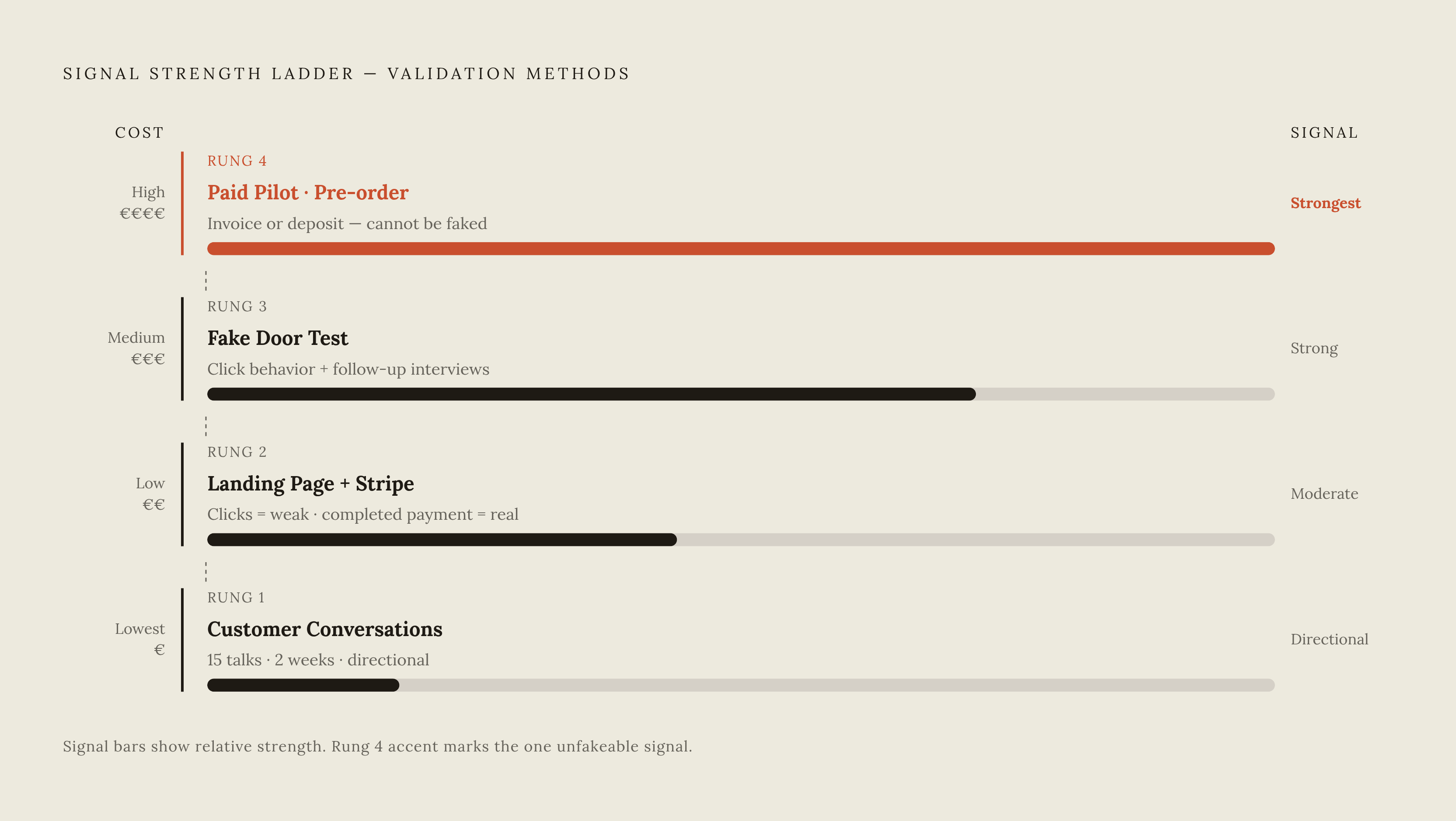
Validation methods aren't a buffet where a founder picks a favorite. They sit on a ladder, where each rung costs more time and money than the one below it, and produces a stronger signal in return. Running them out of order wastes both.
Rung one is customer conversations, the cheapest and most directional method available. Talk to fifteen prospective customers in the first two weeks. Ask about their last week, not about the idea sitting in a notes app. The goal is to surface existing friction, not to pitch a solution, and the questions should center on past behavior: how they currently solve the problem, and what they tried before giving up on it. A prospective buyer who can't name a specific workaround is telling you the problem doesn't hurt enough yet. What people say they'd do is weaker evidence than what they actually do, so conversations point a direction without settling anything.
Rung two is a landing page with a real checkout attached. A single headline, three benefit bullets, some social proof, and a live Stripe Payment Link or deposit link behind the call to action. Clicks and email signups measure interest, but a completed checkout or a deposit is the first commitment signal that means something. Treat the page and whatever ad spend goes behind it as a data purchase.
Rung three is the fake door: a button, feature, or offering presented to real users before it exists, built to measure how many people try to engage with it. This captures revealed preference, what people actually do, instead of stated preference, what they claim they'd do, and it sits between a survey and a working prototype on the cost curve. The limit is sharp: a click measures curiosity, not a purchase decision, and has to be followed by a conversation that asks why someone clicked and what they expected to happen next.
Rung four is the paid pilot or pre-order, the most expensive rung and the one with the strongest signal. Once a conversation has confirmed an active pain point, ask for a pre-order or a signed, paid pilot agreement. A simple invoice or a deposit link settles the question an app store rating never could.
How to run customer conversations that produce real signal
A customer conversation produces real signal only as long as the founder stays in listening mode. The moment it turns into a pitch, it stops working as a validation tool and starts working as a sales call that happens to be unpaid.
Useful questions ask about behavior directly: how do you currently solve this, how much time or money does this cost your team, what software have you tried and why did you stop using it. Each of those questions reveals what someone actually does in their current process, not what they think about a hypothetical product. A prospective buyer either can name a specific, painful workaround they use today, or they can't. Someone who can't name one is handing over the answer without realizing it.
Fifteen conversations across the first two weeks is enough to hear a pattern take shape without burning a month before the pattern is clear. AI tools, research agents, Claude, ChatGPT among them, can now map a competitive landscape and draft a one-page positioning document in a few hours, and that's genuinely useful preparation before walking into these calls. None of it replaces the conversation itself. No AI model knows which buyer will actually pay or which offhand objection is hiding a real demand signal; that only comes from the call. After the first round, write the one-page positioning document and test it on a stranger. If two sentences can't get that stranger excited, no amount of building fixes a positioning problem.
Fake door tests
A fake door test is the fastest way to collect behavioral demand data before a single hour of development goes in, and it's also the most commonly misread method on the ladder. Some founders skip it because they've never heard of it. Others run it and badly overread the result.
The mechanics are simple: place a button, link, or feature representing something that doesn't exist yet, inside a live product, a landing page, or an ad, and track how many people engage with it. The engagement rate is the entire dataset. What makes this more useful than a survey is that revealed preference, someone actually clicking, is much harder to fake than stated preference, someone saying in a survey they'd probably use a feature like that.
The method works well on existing products testing a new feature direction, on landing pages testing different value propositions, and on ad creative testing which pain point resonates. It works poorly on brand-new product categories with no existing user base to click anything, and on complex offers that need real explanation before a click means anything.
A click is not proof that someone will pay, that they'll change how they work, or that they'll still care once the novelty wears off. Pairing click data with a round of qualitative interviews, contacting the people who clicked and asking why, what they expected to find, and what they'd realistically pay, turns curiosity data into something closer to a real answer. Without that follow-up, a high click-through rate can manufacture false confidence, and a founder who reads the number alone risks building the wrong product for the right traffic.
The paid pilot as the final truth-teller before the build decision
Payment is the one signal on this ladder that can't be faked, and the paid pilot is how a founder collects it before a product exists. The instrument is as plain as it sounds: send a real invoice or a deposit link to a prospective customer once a conversation has confirmed an active pain point. If they pay, the bet is worth taking. If they don't, no amount of polished interface design changes that answer.
Pre-orders run on the same logic in a lighter form. A landing page with a working Stripe checkout for a discounted annual or lifetime plan produces a far harder signal than a waitlist that costs a visitor nothing to join.
The Wizard of Oz method extends this one step further. The founder delivers the promised output manually, behind the scenes, while the customer sees a simple front end. This is how Food on the Table got started: the founder built meal plans by hand for individual customers before any software existed to automate the process, and the business grew out of something already generating revenue, not out of a prototype waiting for its first user. That manual delivery does three things no earlier rung can: it proves people will actually pay, it shows what they value in the offer, and it gives the founder room to refine the offer around real usage before any code gets written. The first paying customer from a pilot like this becomes the first case study, the first testimonial, and the source of the exact language that makes later marketing land. Consumer, mass-market products have a harder time running this play than B2B ones do, since there's no single buyer to invoice directly, but the underlying logic, payment over opinion, still holds.
The irony here cuts deepest for founders without a technical background. Platforms like Floot that collapse the time between an idea and a live app raise the stakes on validation rather than lowering them, because the cost of guessing wrong has shifted from months of development risk down to minutes of conversation. That shift hands the real competitive advantage to founders who validate first and build second.
When "validate everything before building" becomes its own trap
Validation discipline can turn into avoidance, and that risk deserves a direct answer rather than a footnote. The ladder exists to get a founder to a build decision faster, not to give them an excuse to keep testing forever.
The real danger is treating "validate before building" as permission to keep running experiments without ever committing to a direction. Each additional rung starts to feel like one more reason not to ship, and that instinct works against the one advantage a solo founder actually has: speed of learning. Seeing an opportunity on Monday and shipping something by Friday is the entire edge. Validation rituals that stretch across months erase it. MagicSchool founder Adeel Khan has pointed out that a single decision-maker can move much faster than a committee, and the validation ladder is meant to aim that speed, not to replace it with a committee of one arguing with itself for months.
The fix is a time limit on every rung. Customer conversations get two weeks. A landing page test gets a week. A fake door result should be clear within days. If the signal is still murky after the allotted window, treat the ambiguity as a no, and either move on or redefine the problem. Pieter Levels' approach is the right counterweight here: charge from day one, and kill ideas that don't produce revenue immediately. A solo founder has no committee to persuade and no investor to update, which is exactly the speed advantage worth using before a larger competitor notices what your customers have already been telling you. None of this replaces judgment. The ladder just feeds that judgment better information, faster.
Building the first version once demand is confirmed
A real signal from the validation ladder narrows the job to building the smallest thing that resolves the single riskiest premise the process surfaced.
Write the idea down as a one-sentence, falsifiable claim about the world, and find the riskiest assumption buried inside that sentence. The riskiest assumption often isn't the technology, but whether people will actually pay, or whether the existing alternative is tougher to dislodge than it looked from the outside. Once that premise is named, V1 should contain only what directly resolves it. If the bet is that designers will pay for auto-generated client reports, V1 ingests one file and produces one report. No teams feature, no history page, no settings screen. One flow, start to finish.
Solo founders routinely overbuild V1 now, precisely because modern tools make every extra screen so easy to add. Each rung of the validation ladder trades time and money for signal quality, and the sequence matters: a founder who tests a fake door or a landing page cheaply can confirm a problem within days, before ever opening a builder, saving the heaviest lift, actual development, for ideas that have already proven there's demand on the other side. Every screen built before that proof exists is a screen that has to be maintained indefinitely, whether or not a single user ever asked for it.