Bring-Your-Own-AI Model With MCP Infrastructure Layers
Models generate logic; infrastructure delivers products.
A capable AI model writes you a working app in about thirty seconds. It cannot put that app on the internet, store a single user's data, or send an email when someone signs up. That gap, between what a language model does and what a real product needs, is the whole story behind the bring-your-own-AI movement. Missing it means the founder ends up staring at a folder full of code they can't actually use.
Most people assume the model is the hard part. Get access to the smartest AI, the thinking goes, and the app basically builds itself. That gets it backwards. The model was never the bottleneck. The bottleneck was always the databases, the login systems, the servers, the email delivery: the plumbing that turns a chat transcript into a product a stranger can use. Nobody talks about it because it isn't flashy, but it's the thing that actually limits what gets built.
A language model generates code and logic, full stop. It doesn't provision a database, manage authentication, or run a server somewhere with your app sitting on it waiting for visitors. A prototype in a chat window is not a live app at a shareable URL, no matter how clean the code looks.
Every real app needs a stack behind it. Backend logic to process requests. Persistent storage so data survives after the conversation ends. Authentication so users log in without someone hand-rolling a password system. Hosting so there's an actual server at an actual address. Email for the moment someone signs up or resets a password. SEO so the app shows up in a Google search instead of vanishing into the void.
Skipping any one of those leaves the founder holding a pile of generated code with nowhere to put it. The AI did its job and wrote the logic, then handed back infrastructure it never touched. Someone still has to handle the databases, the login systems, the servers, the deployment, and that someone was never going to be the model itself.
What MCP is
Anthropic introduced the Model Context Protocol in November 2024, as an open standard. That distinction matters: it determines who controls the tools, and it keeps builders from getting locked into one company's proprietary format.
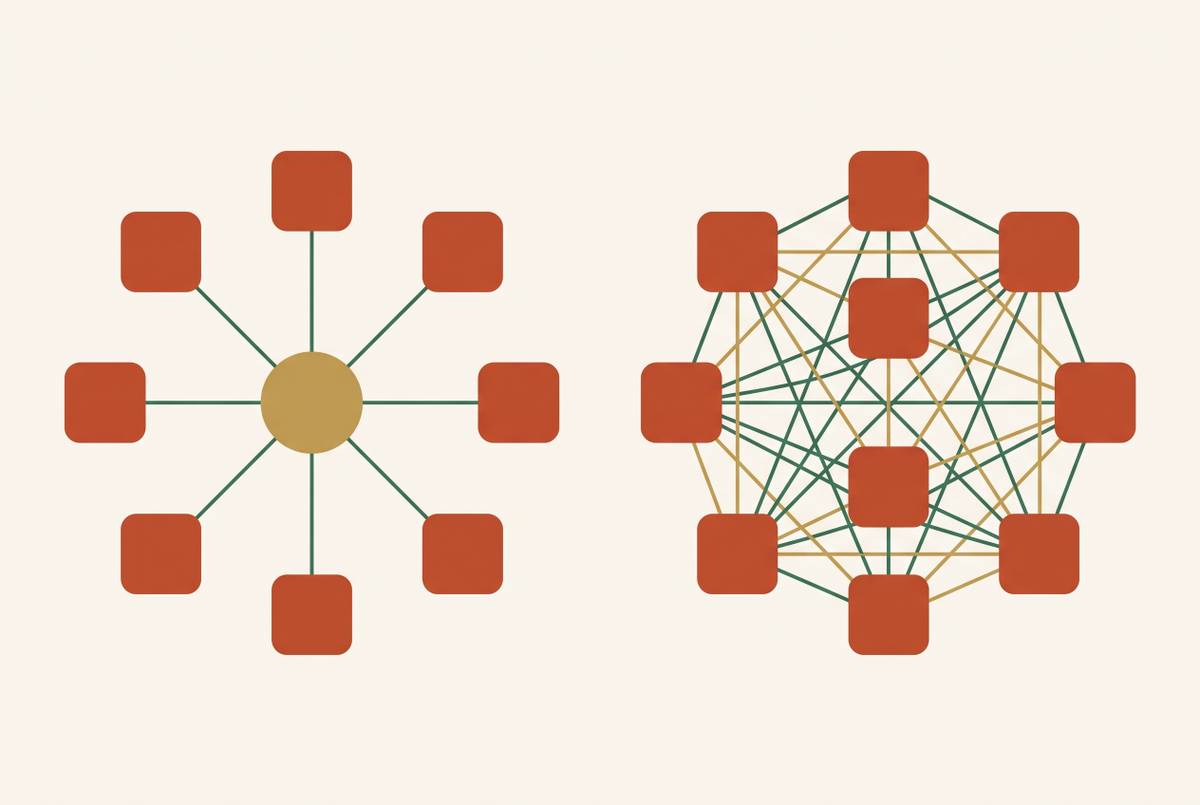
Before MCP, connecting an AI model to outside tools meant custom work for every single pairing. Model A talking to Tool B needed its own connector. Model A talking to Tool C needed another one. Swapping in Model D meant every one of those connectors had to be rebuilt from scratch. Engineers call this the N times M problem: N models, M tools, and a multiplying number of custom integrations that all break the moment anything changes.
MCP flattens that. There are three parts: a Host (the AI app someone's actually talking to), a Client (the protocol connection), and a Server (the program exposing tools, data, or actions the AI can use). Messages travel over JSON-RPC, with both sides negotiating what they're each capable of right at the start of the conversation. Underneath that, MCP gives developers three building blocks: tools (functions the AI can run), resources (data it can read), and prompts (reusable templates).
The comparison that keeps coming up is USB-C for AI. Building the connector once lets any client that speaks the protocol plug into it. Nobody rewrites the cable for every new device.
The real shift is that MCP acts on data instead of just reading it. A model connected through MCP can write to a database, send an email, or trigger a deployment. That's a real departure from retrieval-augmented generation, where the model reads context and answers questions but never touches the system it's reading from.
The momentum behind this isn't small. The MCP Dev Summit in New York City in April 2026 drew around 1,200 attendees, a sign this moved past experimental territory into something engineering teams build on seriously. By mid-2026, more than 10,000 MCP servers were running in production, and the SDKs were being downloaded over 97 million times a month.
The bring-your-own-AI model
Bring-your-own-AI, BYOAI for short, means connecting whichever AI model a builder prefers to the tools they already rely on, instead of getting stuck with whatever model a platform decided to bake in.
That sounds like a small convenience. That convenience is significant. It means picking providers based on price, on capability, or on which model happens to be best at the task sitting in front of you right now. It means sensitive data can stay inside a private or self-hosted model when that matters. And it means swapping to a better model the day it comes out, without tearing apart every tool built around the old one.
Timing makes this more than a nice-to-have. Flagship models have been arriving every few weeks throughout 2026, so chasing "the best model" means chasing a target that never holds still. There's no stable answer to that question anymore. The integration layer, which doesn't need rebuilding every time a new model ships, is the actual asset worth having.
By mid-2026, MCP support had spread across essentially every major AI client: Claude, ChatGPT, Cursor, Windsurf, Microsoft Copilot, Gemini, and Perplexity all support it. Not a niche feature anymore.
Big companies are validating the same pattern from the enterprise side. Palantir rolled out a new registered-models implementation in March 2026. Appspace introduced its own bring-your-own-model setup at InfoComm 2026, wiring together Microsoft Azure OpenAI, Azure AI Foundry, and Google Gemini. Salesforce's Headless 360 now routes interactions through MCP, having processed 4.5 million MCP calls since its April 2026 launch. None of this is fringe experimentation. It's production traffic.
Use the AI subscription already being paid for, add infrastructure on top of it, and skip retraining on a whole new platform just because a better model came out.
What the infrastructure layer has to handle (and why AI cannot delegate it to itself)
"Infrastructure layer" sounds abstract until it gets broken into pieces a non-technical reader can picture.
Backend is the server-side logic that processes requests and enforces how the app behaves. Database is persistent, structured storage, the thing that remembers a user's data after the browser tab closes. Authentication covers user accounts, login flows, and role-based access, none of which can be improvised on the fly without opening security holes. Hosting means a server that's actually running, with a real URL. Email and notifications cover the automatic messages an app sends when something happens, such as a signup, a password reset, or an order confirmation. Server-side rendering, sitemaps, and meta tags fall under SEO, and they appear only when a developer configures them, not simply because the app works.
Generating the code for a database schema is not the same thing as provisioning a live database and wiring it up correctly. Generating authentication logic is not the same thing as enforcing it in production, where one mistake means someone's account gets exposed. The AI writes the recipe. It doesn't run the kitchen, and pretending otherwise is where most of these projects stall out.
That's the real shape of the agentic-coding gap. Tools that let an AI write code still leave the founder holding deployment, environment variables, secrets management, and scaling, each one its own project with its own way to fail.
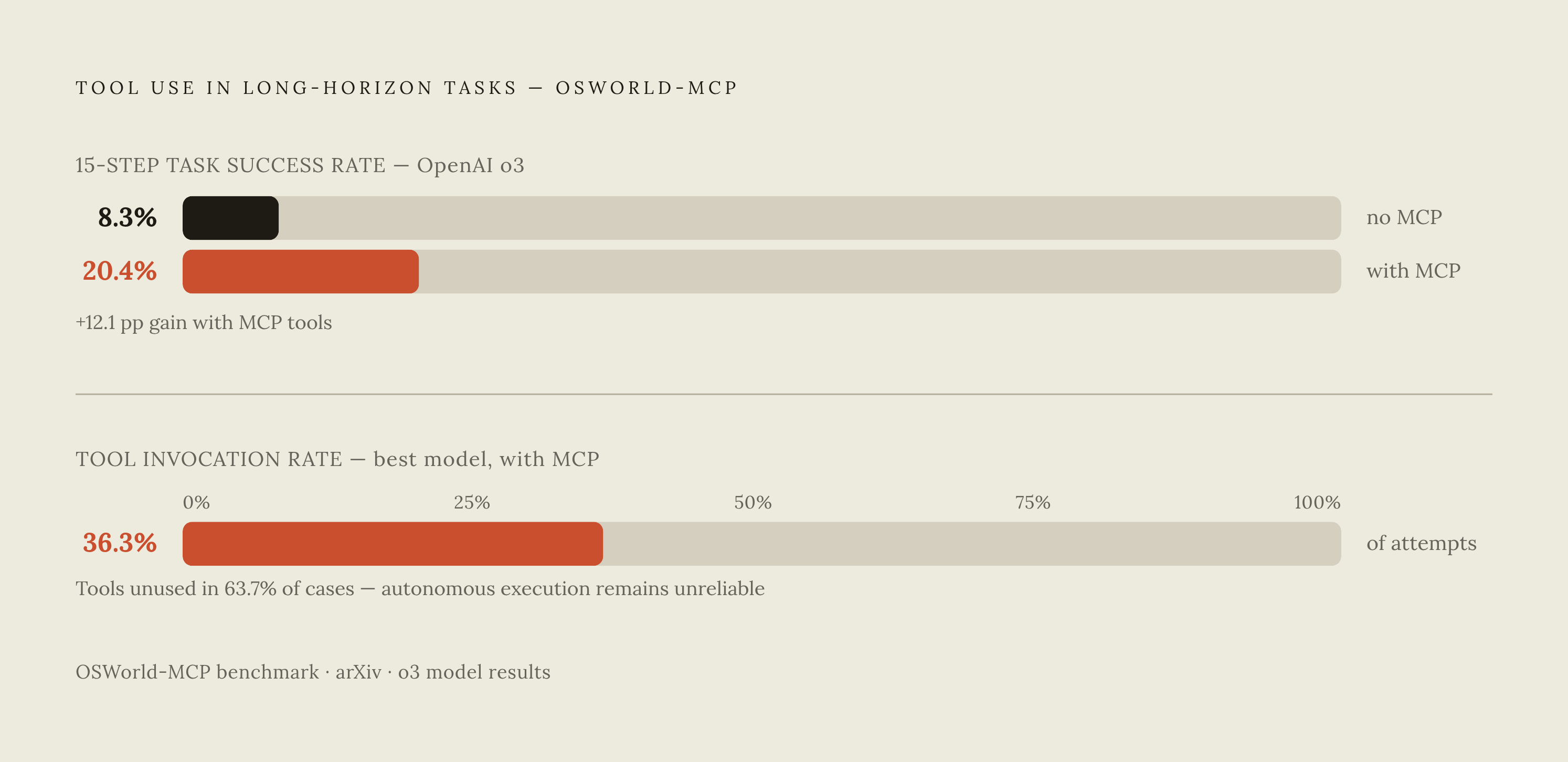
The numbers back this up. An OSWorld-MCP benchmark, published on arXiv, found that connecting MCP tools to models meaningfully improved task success. OpenAI's o3 model, for instance, went from an 8.3% success rate to 20.4% on a 15-step task once MCP tools got added. Real progress. But the same benchmark found that even the strongest models only managed a tool invocation rate of 36.3%. In plain terms: models are still unreliable at running complex, multi-step infrastructure tasks entirely on their own, and treating them like they can is how founders end up with a broken deploy at midnight.
That points to the actual design principle here. Intelligence and infrastructure stay separate. The AI directs. The infrastructure layer executes, reliably, every time, without needing supervision. For a founder, that means never touching a terminal, never setting an environment variable, never configuring a deployment pipeline by hand.
How a managed MCP infrastructure layer connects to the AI the builder already uses
The pattern is simple once it's named: an MCP server provisions and manages the entire stack, and connects to whatever AI the builder is already using through the standard protocol. No new AI to learn. No separate app to log into.
On the builder's behalf, that MCP server handles database provisioning, user authentication and role-based access, storage and file handling, email and notification delivery, live hosting on AWS infrastructure with real preview links, and the SEO basics: server-side rendering, sitemap.xml, robots.txt, canonical URLs, and meta previews for social sharing.
There are two ways this connection gets made. One is local stdio, which for a developer means adding a package to a config file. The other is remote HTTP, which for a non-coder just means pasting a URL into something like Claude's Connectors settings. That second path is the one that matters for most founders: paste a link, and the connection is live.
Inside Claude specifically, MCP connectors can be added to extend what the AI can reach from within the conversation. The result is that the right tools are available when the conversation calls for them, without the builder having to go looking.
What a non-technical founder can ship from a single conversation
Everything happens in plain English. No code, no terminal, no git commands. Just a description typed into a chat window.
A prompt as simple as this works: "Build me a website for my photography studio with a portfolio grid, an about page, and a contact form that emails me." One sentence. That's a complete app description, and it's enough to get a working build started.
From there, the builder watches the app take shape in real time and redirects it as it goes, the same way anyone would give feedback to a person building something in front of them. Plan Mode lets the founder review the app's intended structure before generation starts, so the AI works from clearer context. Once something's built, a visual editor lets changes get made by drawing directly onto the interface, no code required for the iteration that comes after the first draft. Errors get caught and resolved automatically, without the founder ever needing to read a stack trace.
What comes out the other end, by default, is a finished app: a live URL, a working database, user authentication already wired up, email notifications firing on the right triggers, and SEO-ready pages. It runs on AWS infrastructure built to handle real traffic. Builders keep ownership of their code, their data, and their intellectual property, with no lock-in on what they've made.
Adoption numbers point to a production-grade tool, not an early experiment.
Why assembling this stack yourself costs more than it appears
The alternative is doing it all by hand, hosting from one provider, a database from another, authentication from a third, email from a fourth, and SEO configuration bolted on separately from all of it. Each piece comes with its own pricing page, its own setup process, and its own way of breaking at 2 a.m.
The real cost appears later, in the maintenance nobody budgets for: rotating API keys, watching for outages on services the founder doesn't control, patching version mismatches between tools that were never built with each other in mind. That's a part-time job nobody signed up for.
Getcreatr.com's comparison shows pricing across AI app builders in 2026 clusters in a pretty tight band, generally running from around $16 a month on the low end up to around $32 on the high end, depending on the platform and tier. A separate hosting bill, a separate database bill, and a separate email service layered on top of that make the "cheap" DIY stack stop looking cheap fast.
Gartner projects the low-code and no-code market to hit $44.5 billion in 2026. That's a market-sized bet that businesses would rather pay someone else to run infrastructure than build it themselves.
A managed MCP infrastructure layer collapses all those separate line items into one. The founder pays their AI provider for tokens, the actual thinking work, and pays one flat fee for everything else. Predictable, with no markup stacked on top of markup.
The design decision non-technical founders should take away
Intelligence (the AI model doing the thinking) and infrastructure (the managed layer doing the running) are two different concerns. Treating them as one thing is how a founder ends up stuck holding code with nowhere to deploy it.
BYOAI only becomes genuinely powerful once the infrastructure layer is also managed. Skipping that step means a founder is simply picking which AI generates code they still can't ship.
There's a real payoff to keeping these separate: when infrastructure runs independently through MCP, moving to a better model becomes a setting change. Not a migration project, not a rebuild. Just a switch flipped.
Gartner's own projection puts real weight behind this shift: 70% of new enterprise applications are expected to use no-code or low-code technology by 2026, up from under 25% back in 2020. That's a structural change in how software gets built, not a passing trend.
For a solo founder or a business owner building their own product, the practical move is this: pick an AI already being paid for, add an MCP infrastructure layer that handles everything else, and measure time-to-live-app in minutes instead of months. When evaluating that infrastructure layer, look for the full stack included by default (database, auth, hosting, email, SEO), not assembled piece by piece. Look for token costs that stay with the AI provider, with no markup layer sitting in between. Look for something that works inside the AI tools already being used, and something production-grade from day one.
The gap between a founder and a shipped product in 2026 rarely comes down to the AI's capability anymore. Whether a founder ships a product in 2026 depends on whether managed infrastructure sits underneath their AI, because that infrastructure is what turns generated code into something usable.