From Claude Chat to Deployed App Without Touching a Terminal
MCP connectors let Claude and ChatGPT deploy working apps directly from chat.
Building an app with AI meant something narrow until recently: open a separate tool, type a prompt into its own chat window, and hope the output was usable. In 2026, that phrase points to something different. The AI assistant a founder already pays for, Claude or ChatGPT, can now reach directly into production infrastructure and carry a build from first prompt to live, shareable product, without the founder leaving that conversation.
The shift happened fast. Since OpenAI adopted MCP (Model Context Protocol) in October 2025, the same servers that power Claude can power ChatGPT too. That makes MCP close to universal across the two assistants most founders already use every day. A process that used to take five separate technical steps, writing code, configuring a backend, setting up a database, provisioning hosting, and deploying, can now happen inside a single conversation, because MCP lets the assistant operate each of those layers as a tool it calls directly.
One condition decides whether that conversation turns into a real product or stays a pile of text. The chat needs an infrastructure layer underneath it, handling the things a chat window cannot: a real database, user authentication, hosting, and a URL someone else can actually visit. Without that layer, the output is a prototype with nowhere to live.
What the chat window can do on its own
Picture asking Claude to build a client portal. It writes the login screen, the dashboard, the data model for storing client files, the API calls that would connect them. The code is complete and syntactically correct. Then the conversation ends, and the question becomes: where does any of this actually run?
That's the real boundary. A language model in a plain chat window generates frontend components, backend logic, database schema, and the glue code tying them together, all from a plain-English description. The reasoning behind it is genuine, and the code it produces will usually work. But none of it runs anywhere. There's no server executing it, no database holding the data it was designed to store, no domain pointing to it, no login system actually checking passwords. It sits in the conversation as text.
For a non-technical founder, that gap has a blunt consequence: without infrastructure behind it, the output is a well-written document, not a product. Nobody can sign up for it. Nobody can click a button and see something happen. It's a blueprint, not a building.
Before MCP, closing that gap meant a second, harder project. A founder would copy the generated code into an editor, find a hosting service and configure it, provision a database somewhere else, wire up authentication by hand, then figure out deployment. Each of those steps is its own technical wall, and most non-coder journeys ended at one of them, long before a single user ever saw the app. Anyone who has tried asking Claude to "just build my app" and ended up holding code they had no idea what to do with will recognize this pattern immediately. That frustration is the exact problem the rest of this piece addresses.
How MCP turns Claude and ChatGPT into app-building environments
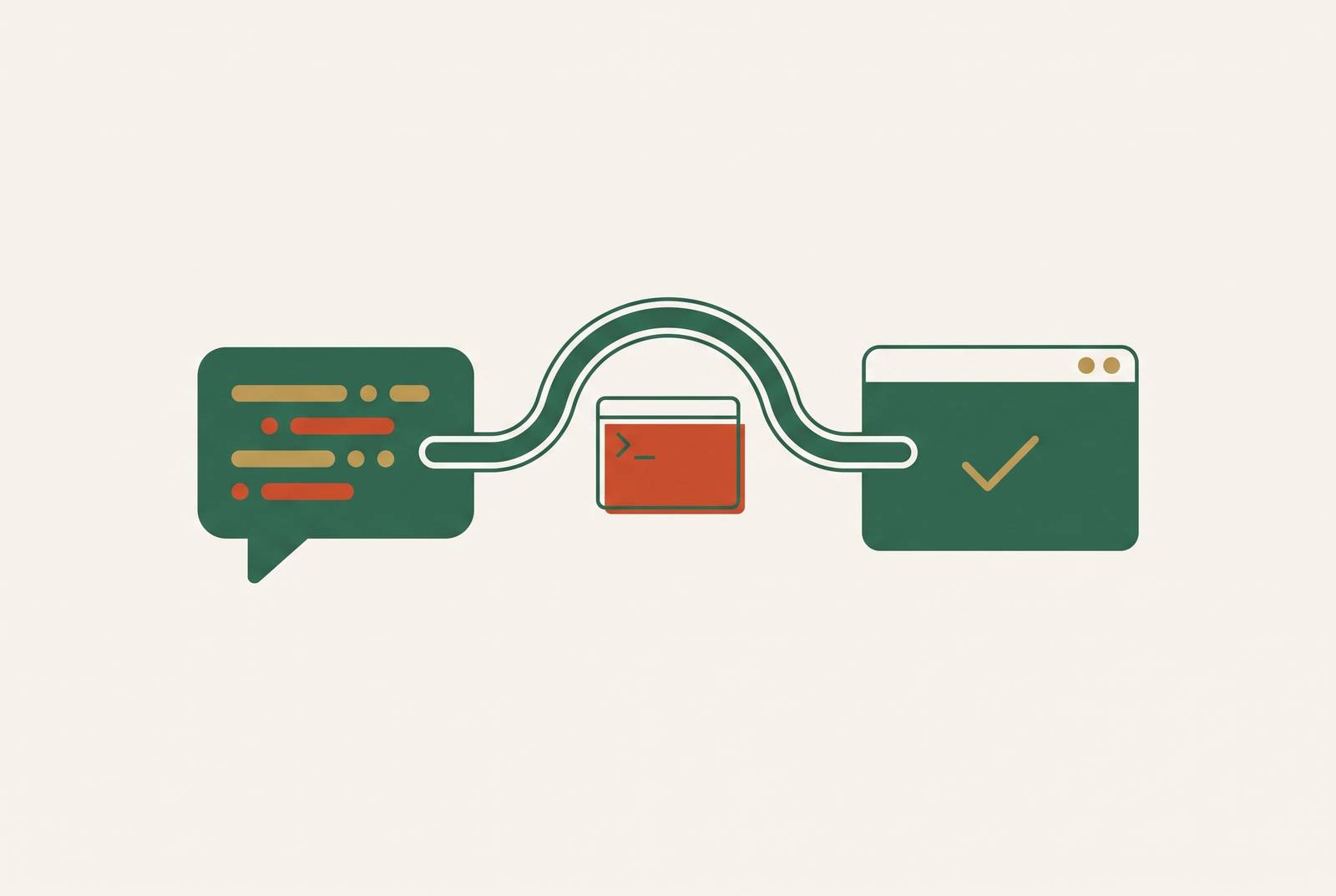
MCP solves that problem by giving an AI assistant a standard way to call tools outside the conversation: reading and writing files, running database queries, triggering a deployment. Instead of describing what code would do, the assistant does it, directly, from inside the chat.
The mechanism is simpler than it sounds. An MCP server is a small program that sits between the assistant and a set of tools. The assistant sees those tools the way a person sees keyboard shortcuts: things it can trigger without needing to understand what's happening underneath. It doesn't need to know how a Postgres database stores rows, or how a deployment pipeline moves files onto a server. It just needs to know the action is available, and when to use it.
In Claude, this shows up as the Customize → Connectors panel. A founder adds any remote MCP server by pasting in a URL, and Claude handles a full OAuth login flow from there. No config file, no terminal, no manual handling of credentials.
ChatGPT added its own version of this in September 2025, through Apps & Connectors settings. OAuth 2.1 is required there. Dynamic Client Registration is available but optional, and ChatGPT leans toward Client ID Metadata Documents for registering a client. Developer mode, available on Business, Enterprise, and Edu plans, gives full read and write access to MCP tools; Plus and Pro accounts are limited to read and fetch.
The practical upshot: one MCP server, registered once, works in both assistants. A founder can configure a connector a single time and use the same infrastructure whether they're working in Claude that morning or switch to ChatGPT that afternoon.
What matters most for a non-technical founder is that the assistant now has hands, not just a voice. A prompt like "add a login screen and store user data" no longer just produces code showing how that might work. It causes the assistant to write to an actual database and configure actual authentication, in real time.
A managed connector, one a platform hosts and exposes as a remote URL, needs no server for the founder to run or maintain. Self-hosting an MCP server is a different animal entirely, with real operational demands: managing processes, watching for failures, keeping the integration current as APIs change. For most non-technical founders, that overhead defeats the purpose. A managed connector is what makes the rest of this workflow realistic.
The promise of MCP only fully plays out when there's an infrastructure layer capable of actually running those tools: a live database, managed hosting, a deployment pipeline ready and waiting. Platforms like Floot sit beneath the AI conversation and turn what Claude or ChatGPT writes into a working, live app.
From a Claude prompt to a live app: the full journey
With an MCP connector handling the infrastructure, the path from typing a prompt to holding a working URL follows a clear sequence, and a non-technical founder can complete every part of it without opening a terminal, touching a config file, or logging into a hosting dashboard.
It starts with connecting the infrastructure layer. The founder adds the MCP connector inside Claude's Connectors panel or ChatGPT's Apps & Connectors settings. From that point forward, the assistant isn't just chatting. It can read and write to the actual project, run the database, and trigger a deployment when the time comes.
Next comes the plain-language description of the app. Something like "build me a CRM for real estate agents with lead tracking, client notes, follow-up reminders, and a dashboard showing active deals" is enough detail for the assistant to start planning and generating. Floot's own documentation uses this exact kind of prompt as a sample starting point, because it maps cleanly onto what the assistant needs to know: who the users are, what data they'll work with, and what they need to see.
From there, the assistant builds and wires the whole stack at once. It writes frontend components, backend logic, and the database schema the app needs, then calls the MCP server's tools to actually write those files, run the SQL that creates the tables, set up authentication, and configure serverless endpoints, all inside the same conversation turn. Nothing here waits for a second tool or a second login.
Once a working version exists, the founder tests it in a preview or sandbox and sends follow-up prompts: adjust this button, add a filter to that dashboard, fix this calculation. Each instruction changes the actual running project. It isn't updating a document that describes the app; it's updating the app itself.
When the founder is satisfied, publishing takes one prompt or one click. That action pushes the app to a real hosted URL, with its Postgres database running, authentication active, and the link ready to send to anyone immediately.
"Live" here means something specific: a real domain, a backend that's actually running, data that persists, user accounts that actually work. Not a static preview only the founder can see on their own machine.
What used to take weeks of freelance development can now close in days for a solo founder, and the entire sequence described above, from first prompt to live URL, can often happen in one sitting. That compression is the payoff: a working link, shareable the same day the idea was typed into a chat window.
What a production-ready app requires underneath
Not every MCP connector, and not every AI builder, actually delivers a finished product. The line between a prototype and something users can depend on comes down to six specific pieces of infrastructure built in from the start.
The first is a persistent database. User data needs to survive between sessions and be queryable later. That means a real Postgres database, not in-memory storage that vanishes when a session ends. Floot includes a real Postgres database on every plan it offers, which is the baseline this category should be judged against.
The second is user authentication. A production app needs accounts, logins, and some form of access control. When that's wired in from the start, the founder never has to bolt on a separate auth service or hand-write session management later.
Third: serverless backend endpoints. Anything that has to run on a server, calculations, third-party integrations, scheduled tasks, needs real backend functions behind it. Frontend JavaScript alone breaks the moment the user closes the tab.
Fourth is scalable hosting with a real domain. The app has to be reachable by anyone, not just visible on the founder's own laptop, and custom domain support matters the moment the app becomes a real product with real users.
Fifth, SEO and discoverability infrastructure: sitemap.xml files, correct meta tag handling, generated automatically rather than requiring a separate technical project for any app that needs to be found through search.
Sixth is email and notification delivery. Production apps almost always need to send something: a confirmation, a password reset, an alert. Without that built in from the start, the founder is left hunting for a separate provider and wiring it in by hand.
When any of these six is missing, the founder ends up right back where MCP was supposed to take them away from: provisioning a database here, an auth service there, a hosting platform somewhere else, an email provider on top of that. That's the exact patchwork this whole workflow exists to eliminate. Every outside service added to the stack is its own bill, its own point of failure, and its own thing to configure and maintain. That compounding complexity is where most non-technical founders stall before ever reaching launch.
Without a database, hosting, authentication, and a shareable URL already built into the platform, the output of even the best conversation stays trapped as a well-written document that no one else can visit or use. This is the real division of labor at work: the AI handles reasoning and code. An infrastructure layer like Floot handles the rest, running the servers, holding the data, managing logins, and putting the finished app on the open web.
The pricing model
A platform that marks up AI tokens, or bills by credit, introduces a cost that grows in ways the founder can't predict in advance. The more someone builds, iterates, and grows, the more the bill climbs with it, often opaquely. That's the opposite of what someone trying to run a real business needs from a tool they depend on daily.
Credit-based pricing shows this clearly. Platforms like Emergent charge per credit, and the cost of a simple landing page versus a data-heavy application can differ by a wide margin. A founder in that model can't forecast a monthly bill without already knowing how complex each future build will turn out to be, which is exactly the thing nobody knows in advance.
Token markups create a related problem. When a platform resells Claude or ChatGPT inference at a markup, the founder effectively pays twice: once to Anthropic or OpenAI for the subscription they already hold, and again to the platform for the same tokens, repackaged and marked up. That's a structural cost built into the pricing model, not a convenience fee.
Floot's structure works differently. When a founder builds through Floot's MCP connector, the actual AI reasoning runs on their own Claude or ChatGPT subscription. Floot charges for platform actions and infrastructure, not for the token inference itself, so the founder pays Anthropic or OpenAI directly, at whatever rate their own subscription already carries.
The way usage limits reset matters too. Floot's action allowance resets daily instead of monthly, so the worst case is losing a day, not burning through an entire month's credit pool in the middle of a project and waiting weeks to rebuild momentum. Under Floot's 2026 pricing, the Pro plan includes 1,000 building actions per day on that daily-reset structure.
Whatever platform a founder chooses, check three things against this standard: flat or predictable infrastructure costs, no markup layered onto model inference, and a clean separation between what the platform itself charges for (hosting, actions, storage) and what the AI provider charges for (the actual reasoning). Pricing clarity isn't a minor preference for someone building a real business. Unpredictable costs make it impossible to know whether the product being built is even profitable, undercutting the entire reason to build it.
What real founders have shipped using this approach
The founders moving fastest with this kind of AI infrastructure aren't outliers who got lucky. They represent a pattern that repeats: speed of execution and speed of distribution now affect outcomes more than technical depth does.
A non-technical founder with a clear idea, a CRM for a specific type of agent, a scheduling tool for a specific type of service business, a dashboard for a specific kind of operator, can describe that idea in plain language and have a working version live within a session. The technical sophistication that used to separate a founder with an idea from a founder with a product has largely moved into the infrastructure layer itself, where it runs quietly in the background.
That's the real change underway in 2026. The constraint on building a real app was never the idea. It was everything standing between the idea and a working link. With MCP connecting Claude and ChatGPT to the database, authentication, hosting, and deployment layer, that distance has mostly closed. What's left is knowing what to build, and for whom.