Legal and Business Basics Solo Founders Skip When Shipping Fast
Founders who delay legal setup until revenue arrives now hit walls platforms enforce at signup.

Solo founding has stopped being the exception and become the default starting shape for a new company. That change is driven by a single person now being able to run product, infrastructure, and customer support with a lean monthly stack of coding tools and automation, work that used to require a small team. The cost of building has dropped. The legal exposure that comes with running a company has not dropped at all, and that gap is now a structural feature of how companies get started, not a one-off mistake a careless founder makes.
Why "ship first, sort it later" no longer works
The common build order goes: make the MVP, find some beta users, worry about paperwork once something is working. For years that sequence was survivable, because legal setup could lag behind the product without costing anything right away. That is no longer true. Stripe, banks, and API platforms now run most of their identity and business checks at account sign-up or when an account moves into a commercial tier, not at the moment the first dollar comes in. Some checks still wait until a volume threshold is crossed, but the bulk of verification has moved earlier in the lifecycle than most founders expect.
Setting up an LLC, getting an EIN, and establishing a business address takes 1 to 3 weeks for a founder based in the US, since EIN issuance can happen instantly online. For a founder outside the US, the same process takes 4 to 8 weeks, because fax or mail filing is often required. A product can pick up its first paying customer within days of launch. If that happens before the entity paperwork clears, the founder hits a wall at the exact moment the product is starting to work. The pause appears as a blocked payout, a frozen account, or a customer who cannot be billed, right when growth should be accelerating.
Entity setup and address consistency: the first thing platforms check and the first thing founders get wrong
Many founders think incorporation is a box they have already checked, and that is often the first place they are wrong. Formation services hand over a registered agent address, not a principal business address, and banks, payment processors, and API platforms treat those two addresses very differently.
Four separate address fields come into play, and mixing them up is the single most common reason incorporation filings get delayed or rejected. The principal business address is the main commercial address tied to the company; it cannot be a P.O. box and shows up on public state filings in most states, though a few, Delaware among them, do not require it on the formation document itself. The registered agent address is the one the formation service supplies. There is also a mailing address, and a founder's residential address, which gets collected for identity checks but is never published.
One failure mode occurs often and is painful to fix after the fact. Stripe has a support address field under Public Details, and if a founder enters a home address there, that address prints on every customer receipt. Once a few thousand receipts have already gone out carrying someone's home address, there is no clean way to take it back. Address mismatches across the state filing, the EIN application, and the bank account can also trigger manual review, which adds weeks before an account clears.
For a founder outside their home country building for customers in another country, forming a local entity there, a C-Corp or an LLC, through a service like Stripe Atlas or a comparable platform, is the step that unlocks everything downstream: banking, payment processing, API billing tiers. A C-Corp is only necessary if the plan involves raising US venture capital; an LLC covers most SaaS businesses that intend to stay bootstrapped. The sequence that holds up in 2026 runs in order: form the LLC, establish the business address, get the EIN, open the business bank account, set up the payment processor, and route all API billing through the business account.
Terms of service and privacy policy: legal documents that Stripe and regulators require, not just best practice
Terms of service and a privacy policy get treated, too often, as things a responsible founder eventually gets around to. They are requirements that outside systems already enforce before a product can take payments. Certain data-privacy regulations apply the moment a founder has a single user in a covered region, with no revenue floor and no user-count minimum, and Stripe enforces related requirements at the account level regardless of how small the business is. CCPA is narrower: it only applies to for-profit businesses that cross one of three thresholds, a revenue floor, a volume of California residents' data bought or sold, or a meaningful share of revenue coming from selling data. A one-person SaaS product with a handful of users can already be subject to the same GDPR obligations as a company serving tens of thousands.
Terms of service do real work beyond formality. They set the rules for using the product, cap the founder's liability, and establish how disputes get handled. Without them, a founder has no contractual ground to ban an abusive user, to push back on a chargeback, or to defend against a claim that the product didn't do what it promised.
None of this requires a custom legal team. Template services like Termly and GetTerms.io, or a single lawyer review of a template, clear the basic bar. The documents don't need to be written from scratch, but they need to exist before the first user signs up, because the obligation to handle data requests and deletion starts the moment a user in a covered jurisdiction creates an account. A 20-person beta that includes EU users already carries that obligation, well before there's any revenue to speak of.
IP ownership and the hidden risk of building on personal accounts
Building fast often means building under personal accounts, paying with a personal card, and never formally assigning the resulting intellectual property to a company entity. That leaves the question of who actually owns the product open to real dispute, and that kind of ambiguity is enough to stop an investor or an acquirer from moving forward.
Code sitting in a personal code-hosting account, a domain registered under a personal name, API keys, and customer data do not automatically become company property the moment a founder incorporates. Each one needs a formal assignment, and that requires paperwork most founders who are moving fast never created. A founder who builds for months, incorporates later, and never signs an IP assignment agreement between themselves and the new entity leaves a hole that due diligence will find, often at the worst possible moment: mid-raise, or mid-acquisition conversation.
The fix costs nothing and takes no time if it happens at formation. Signing an IP assignment agreement is a standard part of incorporation, and most formation services either include it automatically or prompt for it directly. Founders who skip the full formation checklist skip this step along with everything else on it. Contractors raise the same issue in a different form: anyone who writes code, designs an asset, or builds an integration without a written contract assigning that work to the company keeps default ownership of it in most jurisdictions. The founder does not own it just because they paid for it.
Regulated verticals where "ship and iterate" creates criminal liability, not just compliance debt
Some industries turn the general pattern of fixing things later into something far more serious. Fintech is the clearest example. Any product that moves money needs KYC and AML compliance in place from the first transaction. There is no early-stage grace period, and there is no version of "small company, so the rules don't fully apply yet."
Fintech sits at the extreme end, but the same structure appears elsewhere. Health data falls under HIPAA. Products built for children fall under COPPA. Financial advice falls under SEC and FINRA oversight. In each case, the size of the company building the product has no bearing on whether the regulation applies.
The useful move for a founder outside fintech is to check, before writing a single line of product code, whether the vertical carries this kind of regulatory structure. That check takes about 30 minutes and costs nothing. Retrofitting compliance after the product has already shipped can cost the company itself. Andrii Bondar, a product designer who built DecentWealth, a privacy-focused analytics product in the fintech space, alone with AI tools, built it under a named legal identity from day one. That is the opposite of shipping anonymously in a regulated space and hoping no one notices the gaps.
Tax structure and the sole proprietor trap that catches digital nomad founders hardest
Most solo founders end up as sole proprietors by default, simply because that structure requires no action to form, yet it is the least tax-efficient option available, and the rise of founders building while living abroad has made the gap between what people assume and what tax law actually requires especially wide.
A sole proprietorship exists automatically the moment someone starts earning money from a business with no formal entity behind it. A founder who believes they're "just testing the idea before incorporating" is, legally, already running a sole proprietorship and is personally on the hook for the business's debts and obligations. The tax cost is built into the structure itself: sole proprietors pay self-employment tax on nearly all of their net profit, with only the Social Security portion capped at the annual wage base. Electing S-Corp status on that same revenue can reduce that tax bill, and the amount left on the table grows as revenue grows, so delaying the switch gets more expensive over time, not less.
The cross-border version of this trap catches a growing group of founders who build for US customers while living somewhere else. The assumption that living internationally means tax exemption is wrong, and acting on it can produce serious financial penalties, because tax obligations follow the business's customers, its revenue, and its registered entity, not the founder's passport or current address. The fix is not complicated: setting up a Delaware C-Corp or LLC with an S-Corp election, through Stripe Atlas, Firstbase, or a comparable local service, gets the basic structure right. It has to happen before revenue starts piling up under the wrong structure, not after. API spend tells the same story on a smaller scale. Several hundred to several thousand dollars in AI API charges run through a personal card before the first dollar of revenue arrives is a deduction the founder never claims, and a bookkeeping mess that gets harder to untangle the longer it sits unaddressed.
The triggers that turn a skipped step into a blocker
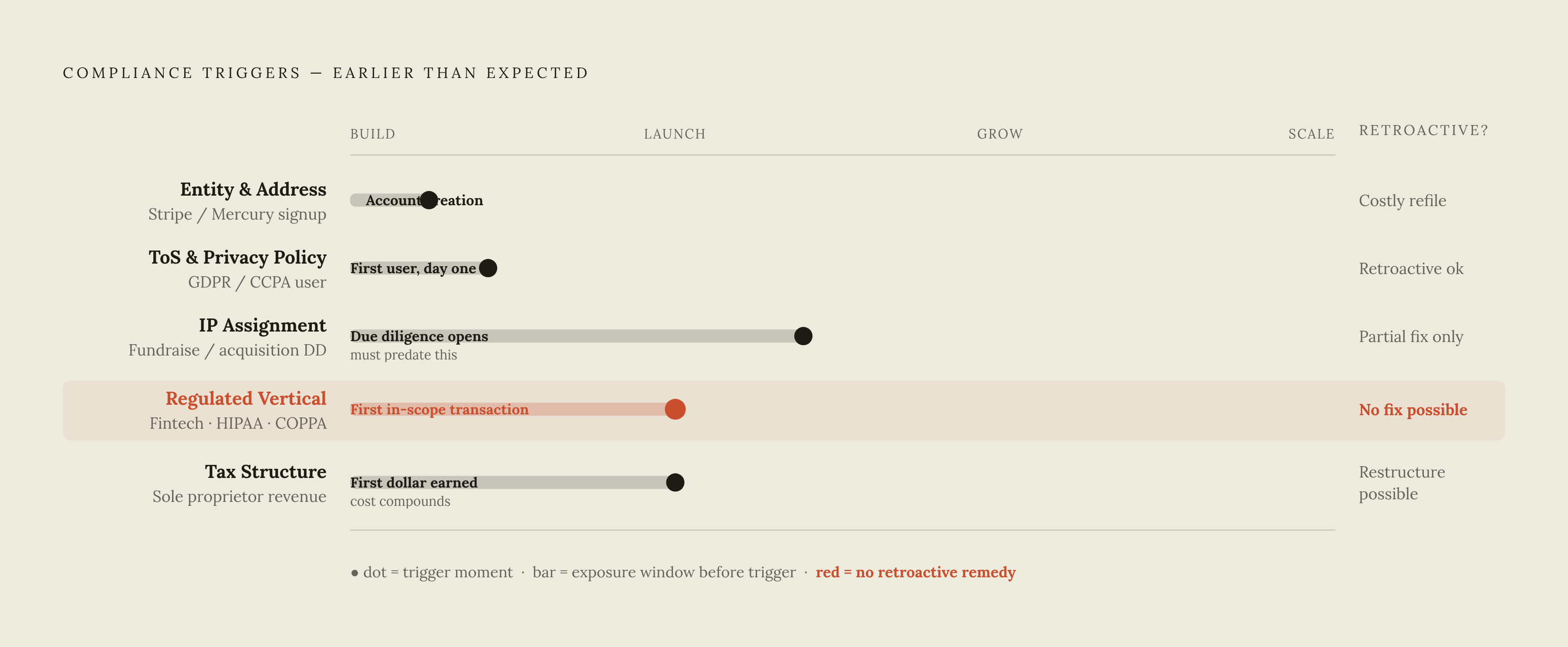
Each of the basics covered so far reaches a specific moment when a missed step stops the business cold, and for most solo founders several of those moments land in the first few weeks of having real users or real revenue. Entity setup and address consistency get triggered the moment an account is created on Stripe, Mercury, or an API platform's commercial tier, and that can happen before a single paying customer shows up. The 4 to 8 week international setup window needs to close while the product is still private, before launch. Terms of service and a privacy policy get triggered by the first user who signs up from a GDPR or CCPA jurisdiction, which for most internet products means day one, and Stripe requires both documents linked from the product before it will enable payouts. IP assignment gets triggered later, usually at fundraising or acquisition due diligence, but the agreements need to have existed since formation; signing them retroactively is possible, but it raises questions about everything that happened in the gap. Regulated vertical compliance, in fintech and similar spaces, gets triggered at the first transaction that falls inside the regulation's scope, with no grace period and no way to apply a fix retroactively once that transaction has happened. Tax structure gets triggered by the first dollar of revenue earned under a sole proprietorship, and the longer that revenue keeps accumulating under the wrong structure, the bigger the eventual tax exposure and the messier the correction.
The pattern across all five is the same: the trigger appears earlier than most founders expect, and the cost of having skipped the step grows with how long it sits unaddressed. A fix that takes an afternoon at formation turns into a problem that takes weeks or months once the trigger has already hit. Marc Lou's ShipFast boilerplate, which has crossed a million dollars in revenue, includes ChatGPT prompts for generating Terms and Privacy documents and ships standard Stripe configuration as part of the base package, not as something bolted on later. Among the founders most associated with shipping fast, these basics are treated as part of the foundation, not as chores to get to eventually.
What production-ready infrastructure for solo founders requires
The same thinking that solves the legal and business problem, handling complex and easy-to-miss requirements automatically so the founder's attention stays on the product, is what separates infrastructure built for production from tools that help someone ship quickly but leave the operational risk sitting with the founder.
Clearing the legal and business basics does not finish the job. A second layer still has to work: backend logic, database storage, user authentication, scheduled tasks, email notifications, search visibility, and hosting that holds up as traffic grows. Each one of these is another spot where "deal with it later" quietly turns into a blocker down the line. The common failure pattern mirrors the legal one almost exactly: subscribing to a separate tool for coding, another for automation, another for project tracking, and another for hosting creates overlapping features, no shared context between them, and a stack of monthly bills that grows as the product grows, the same compounding dynamic that makes unaddressed legal debt so costly.
The underlying principle is the same on both sides of the problem. The distance between having an idea and having a live, working product should be measured in minutes, not months, and getting there requires infrastructure that absorbs the complexity automatically rather than a checklist the founder has to manage by hand. Pay-per-token pricing on the infrastructure side behaves like the sole proprietor trap on the legal side: small per-transaction costs that feel harmless individually and compound into something unpredictable. Flat, predictable infrastructure pricing plays the same role that the right legal structure plays on the business side. Both let a solo founder scale without getting blindsided by a cost or a blocker they didn't see coming.