Why Your AI App Builder Should Own the Build Pipeline Not Just the Code
Owning the build pipeline separates AI builders that ship products from those that ship code.
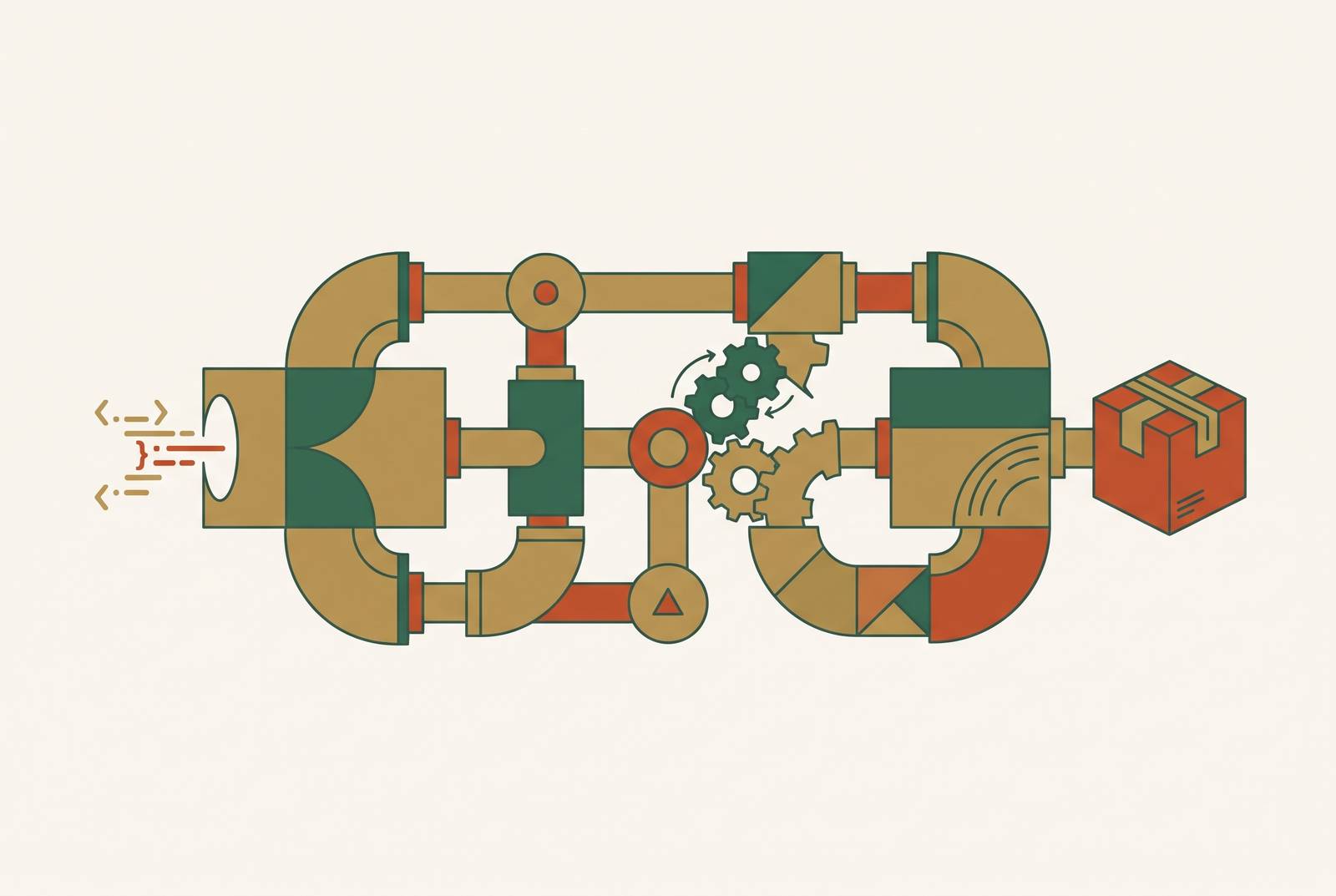
To publish an AI-built app for iOS and another mobile platform without the platform-specific computer or development environment, a builder needs more than generated code or a live web URL. The builder must support the mobile stack and store submission. The tools documented here do not establish that complete workflow. The broader buying rule is clear, though. An AI app builder should own the build pipeline, handling the work between generated code and a running product.
How the AI app builder category split into three distinct types
Product agents, coding agents, and prototyping platforms each answer the same question in a different way. How much of the work does the tool take on? A product agent turns a plain-language specification into a deployed full-stack app, including the backend, database, authentication, frontend, and deployment. A coding agent edits code in a repository the user already owns. The user remains responsible for the pipeline that turns those edits into a running app.
Prototyping platforms occupy a different part of the category, where producing a prototype does not by itself establish responsibility for production infrastructure. Two tools can both take prompts and build screens that look finished, yet leave very different amounts of work to be done. That makes “does it use AI?” a weak buying question. Buyers need to establish who owns the work between the prompt and the live URL.
What "bolt-on stack" architecture actually means for the builder using it
Code ownership has several layers, and downloading frontend files covers only one of them. Database migrations, server functions, deployment configuration, and a reproducible build are each their own part of the app. A tool can hand over the visible code while leaving those parts tied to other services. That is not necessarily a bad bargain. But it is a narrower form of ownership than the download button might suggest.
A bolt-on stack assembles an application from outside infrastructure. The frontend is one artifact, the backend runs on a separate platform, and authentication may come from another provider. This is a deliberate shortcut to market. Those services already exist, so the builder does not have to create each capability itself. In return, the user's app relies on several systems, each with its own owner and ways it can fail.
Data lives in one service, permissions may live in another, and deployment has its own configuration. Each service also has its own pricing clock. The resulting app may work well, but someone still has to reconcile the parts. If that responsibility belongs to the user, the tool generates code without owning the complete pipeline.
Where stitched stacks quietly cost more than builders expect
Existing services and free tiers let a solo founder with little money to spare get started with a stitched stack without paying for much infrastructure. Growth changes the calculation. Backend hosting, storage egress, authentication, email delivery, and API overages can appear on separate invoices at separate thresholds. The builder subscription is therefore only part of the cost of running the app.
Jack Friks built Post Bridge with Next.js and Supabase, then migrated its storage from Supabase to Cloudflare R2 because egress costs were large and growing. The cost came from moving stored data out. Fixing it required changing where the product stored that data. The example shows how a dependency that works at launch can later demand an architectural change.
Credit-based AI builders add uncertainty during development as well as operation. Complex builds and error retries can use up credits faster than expected, so spending is hard to predict unless someone keeps track of it. Cheap entry still has a legitimate purpose. The price to get started can mislead buyers who treat it as what the product will cost to run over time. A free tier can help validate an idea while leaving a growth tax waiting in another part of the stack.
What native-stack compilation actually does differently
Native-stack compilation generates backend methods, the database schema, authentication roles, and the frontend from the same source of truth. The specification describes the application as a whole rather than leaving the user to join separately generated parts. That changes the unit of work. Instead of producing a frontend that needs a backend attached, the compiler produces a coordinated full stack. Nothing between the prompt and the live URL needs to be stitched together by the user.
Remy follows this spec-driven product-agent model, with the specification remaining the persistent source of truth as the product evolves. It is not merely a chat log. Iteration happens by editing the specification and recompiling, rather than re-prompting and manually reconciling the changed pieces. There is no third-party database service to configure separately or authentication provider to wire in by hand.
Here, “native-stack” describes how the application's layers fit together. It does not establish native delivery for iOS or another mobile platform. A buyer who needs App Store submission and submission to another mobile platform's store needs proof that the tool can do both, even when a product agent handles all of web deployment.
Why the gap between prompt and live URL is where real products are won or lost
Panche Isajeski rebuilt AgentOS for the current market and reached meaningful MRR two months after launch. The business is fully bootstrapped and runs with zero employees, with AI agents handling onboarding, support, operations, and much of the code. That is an operating business.
Stripe's data shows that the share of profitable SaaS products run by a single founder has roughly doubled since 2023. The increase makes the operating model harder to dismiss. A solo founder has to keep a product that earns money working for its users after the code is generated. Each required infrastructure handoff gives that same person more work to do or find another way to cover.
The decisive gap is therefore not the number of clicks in a deployment screen. It is the unfinished responsibility behind those clicks. An app that renders correctly but still needs its database, permissions, or hosting reconciled has not completed the journey from idea to product. The founder still owns the missing work. Pipeline ownership pays off when it takes that required work off the founder's hands, beyond speeding up the first demo.
The infrastructure concepts non-technical founders most often discover too late
The backend and database become visible when a screen needs to do more than display sample content. Getting data in and out through API calls is a common bottleneck. A frontend generator pushes that work back to its user. Some full-stack builders add integrated AI agent builders on top of their full-stack capabilities to make it faster. The practical distinction is whether the tool completes the data journey or leaves the connection unfinished.
Authentication becomes visible when a login screen needs to manage real access. User login, session management, and role-based permissions are infrastructure. If the builder does not own this layer, a separate authentication provider still needs to be configured. The need to do that work may stay hidden until different users need different permissions.
SEO rendering becomes visible when a launched app fails to attract the organic traffic its founder expected. Some generated single-page apps render on the client, which limits their SEO. Server-side rendered output is indexed more reliably by search engines. Both can look finished in the browser but differ in how well search engines can index their content.
Mobile infrastructure becomes visible when “it works on a phone” turns into a requirement for push notifications, in-app purchases, or App Store presence. Most AI builders make web apps or PWAs. To meet those mobile needs takes a whole different stack. A live URL does not prove store readiness, and developer accounts do not establish that the builder handles submission. This is where a web-first purchase can fail to answer a mobile-first need.
Deployment becomes visible when the app needs hosting, SSL, a custom domain, and a repeatable way to publish changes. The strongest builders handle that work with one click. But deployment can stay out of sight only if the tool owns that layer. In a bolt-on stack, someone may still have to set up those settings on their own. The apparent simplicity of the editor says little about who is responsible for getting its output live.
What MCP connectors add to the pipeline ownership question
MCP connectors let AI tools perform actions. That opens another route to pipeline ownership. Instead of moving from an AI conversation into a separate builder interface, the user can operate managed infrastructure through the AI environment already in use. For a full-stack infrastructure layer exposed this way, deployment, database, and authentication work can stay inside that environment. The interface changes, but someone still has to do the work underneath it.
Zarla's official MCP page says an assistant can build, edit, and publish a hosted website after the user connects and signs in. It also says there is no hosting to set up and nothing to install. That is a concrete publishing capability. Its scope, however, is a hosted website. It does not establish native mobile compilation or submission to the App Store and another mobile platform's store.
The connector itself is therefore not proof of complete pipeline coverage. What counts is the infrastructure it can operate. An AI interface connected to a managed full stack can keep the work in one place, while a narrower connector handles only the tasks exposed through it. Who takes responsibility for the application layers the user needs, including the final destination where the product must run?
How to evaluate whether a builder actually owns the pipeline or just claims to
The practical test is to separate what the tool owns from what it hands back to you. “Full-stack” and “no-code” are not enough on their own. Start with whether the generated app completes the full user journey or merely renders screens. Then ask whether the backend is native to the tool or a third-party service wired in. Ask separately whether authentication is built in or requires another provider to be configured.
Next, examine what happens after the first successful build. Can one feature change without breaking other parts of the app? Is deployment one step, or does it require separate configuration? These questions expose iteration safety and the remaining handoffs. An app that looks finished on the first build can still need its parts pieced back together after each change.
Can you retrieve the code, data, configuration, and migration history if you leave? Is pricing flat and predictable, or credit-based and variable? Finally, is there a documented repair workflow for when the AI gets stuck near the end of a build? That last question targets the point where generated output can look nearly complete while still being unusable.
A buyer who wants to publish to both mobile stores without a platform vendor's computer or development environment also needs to check what the tool can do beyond web hosting. The evidence needs to cover the mobile stack and store submission. The supplied product details do not establish that end-to-end option.
Speed still matters when testing an idea, and a bolt-on stack may get a prototype live faster. Before accepting the first paying user, confirm that the tool owns the full pipeline the product needs. Once real users, data, and revenue depend on it, an unexpected egress bill, a separate authentication outage, or unfinished deployment work becomes a business risk.